

The Editio Critica Maior defines a “variant” as a reading that is both “grammatically correct and logically possible.” If it doesn’t meet these two criteria it is marked with an f for Fehler (= error). Neither criteria is completely objective, but then most of the errors so recorded in the ECM are pretty obvious gibberish. Occasionally, however, one finds cause for disagreement. Here’s an example.
At James 2.3, minuscule 1563 reads:
Speaking of this variant, Klaus Wachtel explains that
Nothing of great significance follows from this except that editors have to make judgments and you may not always agree with them. So it may be something worth checking.
At James 2.3, minuscule 1563 reads:
...καὶ τῷ πτωχῷ εἴπητε· σὺ στῆθι ἐκεῖ ἐπὶ τὸ ὑποπόδιόν μου.
...and to the poor you say, “You stand there on my footstool.”
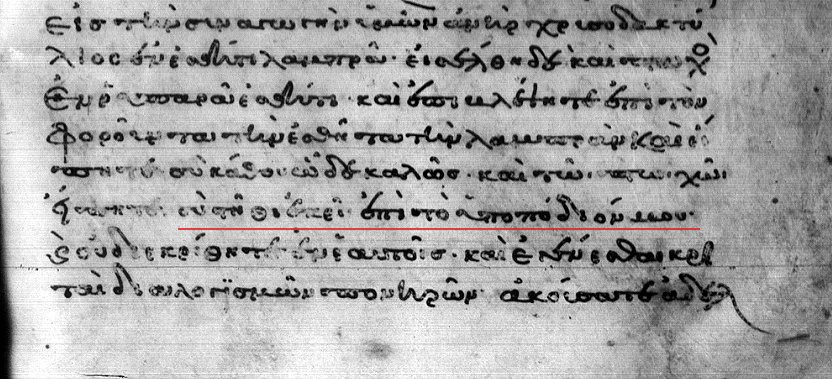 |
| GA 1563 at Jas 2.3 |
Reading f [εκει in 1563] is marked as an error by an additional f (for the German Fehler). That it is an error becomes clear if we compare the reading of 1563 at the next passage of variation (50-56b) where it reads ἐπὶ τὸ ὑποπόδιόν μου, resulting in the request Stand there on my footstool.Now standing on a footstool seems a bit odd to me but hardly impossible—either logically or physically. But maybe the editors have a different conception of “impossible” than I do.
Nothing of great significance follows from this except that editors have to make judgments and you may not always agree with them. So it may be something worth checking.