


Showing posts with label CSNTM. Show all posts
Showing posts with label CSNTM. Show all posts
Friday, February 13, 2026
News from CSNTM: Digital Manuscript Collection Interface is Coming!
Thursday, December 11, 2025
Call for Papers: 2026 CSNTM Conference
The next CSNTM Text & Manuscript Conference is scheduled for May 28-29, 2026 in Plano, TX (just north of Dallas). I went to the inaugural conference and really enjoyed it. This year's theme is on the ECM and the call for papers has just gone out. Here are the details:

Wednesday, November 29, 2023
Call for Papers: 2024 CSNTM Text & Manuscript Conference
From Dan Wallace and CSNTM:
The Center for the Study of New Testament Manuscripts (Plano, Texas) welcomes proposals for the second CSNTM Text & Manuscript Conference, scheduled to take place on 30–31 May 2024 in Plano.I spoke at their inaugural conference and really enjoyed it. It was the perfect size for a conference like that. If you're interested, make sure you apply.
The theme of the conference will be “Intersection.”
In keeping with this theme, we invite papers that explore ways in which New Testament Textual Criticism interacts with other disciplines (paleography, art history, exegesis, paratext, linguistics, conservation, etc.) to inform our understanding of the New Testament transmission in its broad context.
Each paper will be slotted 35 minutes, including time for Q&A. Titles and 300-word abstracts should be submitted via email to Denis Salgado at dsalgado@csntm.org and Mark Gaither at mgaither@csntm.org. Deadline: 31 January 2024
This call for papers is also available at TextAndManuscript.org.
Selected papers from the previous conference (Pen, Print, & Pixels, 2022) have been published by Hendrickson and are available for purchase here.
For more information about the conference, including venue and registration, visit the "Intersection" registration page here.
You may also secure your hotel accommodations at the conference discount rate here.

Monday, October 30, 2023
Update from CSNTM on Their Oxford Expedition
Here’s a nice video from Dan Wallace on their recent trip to the Bodleian. Sounds like they made some exciting discoveries, including several palimpsests that may become legible finally.
Thursday, June 16, 2022
Pierpont’s unpublished papers
Thanks to the generosity of Maurice Robinson, one of my recent projects at CSNTM (where I have been a full-time Research Fellow since August 2020) has been scanning the unpublished papers of William G. Pierpont (1915–2003; see his obituary by Robinson in the TC Journal, here). Robinson is now the custodian of the papers, which include many short studies, remarks, letters, etc. It is a fascinating group of papers, and it seems like there’s a little bit of everything in there (there is even a very interesting one-pager in which Pierpont [who knew something like 20+ languages] analyzes a 13-second recording of an instance of glossolalia, transcribing it, breaking it down into syllables, making observations on frequency of sounds, etc. It’s remarkable!).
Eventually, I hope to put much of the material online at CSNTM. We’re working on adding a section to our website for materials relevant to the text and textual history of the New Testament that aren’t Greek manuscripts or printed editions (e.g. the manuscript of Legg’s unpublished edition of Luke’s Gospel, which J.K. Elliott allowed us to digitize a couple months ago).
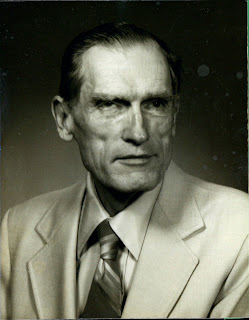 |
| William G. Pierpont (photo c. 1980) |
While I am not a Byzantine prioritist myself, I have the greatest respect for both Robinson and Pierpont and have deeply enjoyed reading much of the material. The reverence for God’s Word these men had while preparing their edition (2018 edition available here) is both convicting and encouraging. In his unpublished papers, Pierpont is thoroughly Christian in everything he writes, and I can’t express how much I appreciate that.
With Robinson’s permission, I am preparing a “guest post” by Pierpont (assuming they don’t kick me off the blog first for stirring the pot too much!). In the next few days, I’ll post here one of Pierpont’s unpublished papers. They are almost all very short—this one is one of the longer ones at about 4 pages long. I hope Pierpont's writings are as edifying to you as they have been to me.
Monday, December 20, 2021
CSNTM at Houston Baptist University
A couple weeks ago I was in Houston with a few others from CSNTM. We have some brand new equipment that we were using at the Dunham Bible Museum at Houston Baptist University. The museum's director, Dr. Diana Severance, graciously allowed us to come photograph some of the early printed editions of the Greek New Testament in their collection.
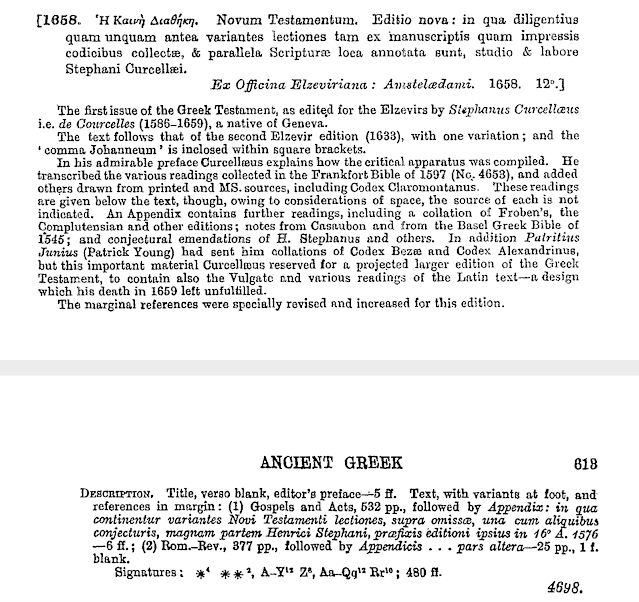
One interesting edition that caught my attention is a 1658 Elzevir edition edited by Étienne de Courcelles in which the Comma Johanneum was placed in brackets, indicating doubts to its authenticity. Here is a photo of that page—thankfully the images we took with our digitization equipment are of much better quality. Keep an eye out for images at CSNTM in the coming weeks.
 |
| 1658 Elzevir text, edited by Étienne de Courcelles |
Darlow and Moule's description of this edition is as follows:
Tuesday, December 07, 2021
CSNTM 2022 Text & Manuscript Conference
Readers may have heard that CSNTM is hosting its inaugural Text & Manuscript Conference May 19-20, 2022. The theme is Pen, Print, & Pixels and will feature plenary presentations throughout each day with optional breakout sessions. Full schedule and registration are at conference.csntm.org.

Plenary Speakers
- Hugh Houghton, “The Importance of Catena Manuscripts of the Greek New Testament”
- Dirk Jongkind, “On Singular Readings and Knowing When the Time Has Come for Better Tools”
- Jan Krans, “New Testament Conjectural Emendation: Folly or Duty?”
- Holger Strutwolf, “The ECM of Mark: Philology in the Digital Era”
- Kathleen Maxwell, “From the Coronis to the Blütenblattstil: The Decoration of the Greek Gospel Book”
Breakouts
- Juan Hernández, “The Significance of the Corrections of the Apocalypse in Codex Sinaiticus”
- Timothy Mitchell, “Exposing Textual Corruption in the Wider Circulation of the New Testament Writings During the Greco-Roman Era”
- Peter Montoro, “Two Way Traffic on the Transmissional Highway? Considering Chrysostom’s Exegesis as an Explanation for the Reading of GA 104 in Romans 2:26”
- Ryan Giffin, “Philippians in P46: Interesting Departures from the Standard Critical Text”
- Craig Evans, “How Long did the NT Autographs Survive? A Review of the Evidence”
- Christian Askeland, “Digital Images, Ancient Manuscripts, and Intellectual Property”
- Jeremiah Coogan, “Marginal Matthew: τὸ ἰουδαϊκόν in Medieval Manuscripts and Modern Editions”
- Edgar Ebojo, “‘Now the end is near’: Pen and Phenomena at the Line-ends of P46”
- Keith Elliott, “The Editio Critica Maior of Mark: Translation from German into English”
- William Warren, “From Ink to Exegesis: The Importance of Non-original Variant Readings”
- Grant Edwards, “Between Codex and Colophon: Ancient Book Format and the Limitations of Paleography”
- James Prothro, “A Theology of Textual Criticism? Searching for a Framework”
- Georgi Parpulov, “Levels of Style in Byzantine Calligraphy”
- Peter Gurry, “Textual Criticism in Early Protestant Bibles”
Tuesday, January 26, 2021
New CSNTM Manuscript Viewer
CSNTM has launched a revamped manuscript viewer on their website and it’s quite nice. The main image is much bigger and—my favorite feature—you can make it even bigger by toggling the various panes for filters, thumbnails, and details. As always, their filters are very handy for finding certain features in the manuscript. You can read more about it here.

Friday, January 15, 2021
A claim that Jesus was a woman(!) and other things I’ve read about recently
Now that I’ve got your attention with my shamelessly clickbaity title, I mention below some observations from my recent reading. But the titular claim is not the only thing I could have used as clickbait! Below are discussions on a manuscript that contains the Comma Johanneum, facsimiles of the Chester Beatty papyri, and even a romance novel inspired by a manuscript!
1. Andrew J. Brown on Codex 61

Tuesday, October 08, 2019
Corrections in P46
Jacob W. Peterson has a new article out on the corrections in P46, the very useful, ‘An Updated Correction List for Chester Beatty BP II & P. Mich. Inv. 6238 (Gregory-Aland Papyrus 46 [P46])’ BASP 56 (2019), 173-195.
Abstract:
This study offers an update to previous works on the scribal corrections in Papyrus 46 (P46) of the Pauline Epistles. These prior studies are introduced and used for comparison throughout. Using the latest digital images, I identify thirteen new corrections, show that four previously identified corrections are doubtful, and provide clarification for seven difficult to interpret correction events. An updated total is provided as well as the distribution of corrections by each hand and book.

Abstract:
This study offers an update to previous works on the scribal corrections in Papyrus 46 (P46) of the Pauline Epistles. These prior studies are introduced and used for comparison throughout. Using the latest digital images, I identify thirteen new corrections, show that four previously identified corrections are doubtful, and provide clarification for seven difficult to interpret correction events. An updated total is provided as well as the distribution of corrections by each hand and book.

Monday, July 29, 2019
Support CSNTM
Dan Wallace shares a very nice video explaining CSNTM’s mission. As someone who has both worked with CSNTM and benefits significantly from their work, I would encourage you to support them.
More from Dan:
More from Dan:
As we point out in the video, our work is urgent and significant. Manuscripts are deteriorating, some at an alarming rate. What is not mentioned is that CSNTM is funded solely by donations. Although hundreds of thousands of manuscript images can be viewed for free, they are costly to produce and archive. To digitize a single manuscript costs the Center $7500. Our job is a long way from being completed. And all these projects require funding. I’m asking you to consider making a donation to the Center.
We need more people to become part of the “Circle of Friends”—those who partner with us by donating monthly to our mission. Even more pressing is the need to fund projects that are waiting in the wings. Would you consider helping the Center in its mission to preserve unique, handwritten copies of the Christian Scriptures?
As I mention in the video, a thousand years ago a monk named Andrew wrote a personal note at the end of the manuscript he was copying: “The hand that wrote this is rotting in the grave, but the words that are written will last until the fullness of times.” His words have become our mission statement. Won’t you join us?
Monday, July 30, 2018
David Smith: Why GA 1411 Should Not be GA 1411: On Classifying Catenae Manuscripts
The following is a guest post from David C Smith. David and I worked together a few years ago in Athens with CSNTM. He is completing a ThM at Dallas Theological Seminary and is a Deacon in the Anglican Church in North America. His masters thesis, entitled “A Study of the Text and Paratext of the Catena on Luke in GA 1441,” should be completed this summer. Here is some of the fruit of that work.
 The question of Catenae Manuscript classification has been raised by some as the details and purpose for composition have been more clearly understood. I wish to contribute some data to the conversation that has come from my work on GA 1411, a relatively unexplored and unanalyzed MS from the National Library of Greece. I was fortunate enough to digitally preserve this artifact with my good friend Andrew Bobo as we worked for CSNTM in the summer of 2015.
The purpose and use of catenae manuscripts has been explained more fully in the NTTC world by scholars such as William Lamb, Hugh Houghton, and David Parker. Lamb in particular has argued that these manuscripts were not primarily written as witnesses to the New Testament, but were written as educational textbooks in the medieval Byzantine scholastic context. Much of his argument is based on situating these manuscripts in their historical context, and in turn showing how this understanding of the compositional purpose of catenae manuscripts explains the high amount of variance in not only their biblical text but in their patristic commentary. In addition, this explanation of their purpose calls into question their use as witnesses of the New Testament alongside other continuous-text manuscripts, which are clearly written to transmit the NT text.
For many reasons, not much work has been done on the Greek catenae manuscripts as artifacts to see if the actual details of the manuscripts support this conclusion from Lamb and others. That is, if we were to examine the textual and paratextual details of a given catenae manuscript, would the phenomena of the artifact be best explained by the theory that they are educational textbooks/anthologies?
My master’s thesis at Dallas Theological Seminary is a study of GA 1411 to attempt exactly this. I am trying to observe the details and phenomena of this manuscript to judge whether or not Lamb’s explanation best fits.
Introduction

The purpose and use of catenae manuscripts has been explained more fully in the NTTC world by scholars such as William Lamb, Hugh Houghton, and David Parker. Lamb in particular has argued that these manuscripts were not primarily written as witnesses to the New Testament, but were written as educational textbooks in the medieval Byzantine scholastic context. Much of his argument is based on situating these manuscripts in their historical context, and in turn showing how this understanding of the compositional purpose of catenae manuscripts explains the high amount of variance in not only their biblical text but in their patristic commentary. In addition, this explanation of their purpose calls into question their use as witnesses of the New Testament alongside other continuous-text manuscripts, which are clearly written to transmit the NT text.
For many reasons, not much work has been done on the Greek catenae manuscripts as artifacts to see if the actual details of the manuscripts support this conclusion from Lamb and others. That is, if we were to examine the textual and paratextual details of a given catenae manuscript, would the phenomena of the artifact be best explained by the theory that they are educational textbooks/anthologies?
My master’s thesis at Dallas Theological Seminary is a study of GA 1411 to attempt exactly this. I am trying to observe the details and phenomena of this manuscript to judge whether or not Lamb’s explanation best fits.
Wednesday, June 06, 2018
CSNTM Aquires MSI
Great news from CSNTM this last month. They have been working on raising funds for a multi-spectral imaging (MSI) camera and they have now acquired one. Just last week they posted photos of the team training on the new machine.


I have heard from staff there that they already planning to use it on trips planned for this summer. For those who don’t know, MSI is extremely helpful for reading palimpsests and was used extensively, for example, on the Sinai Palimpsest Project. I am sure this new tool will make CSNTM even more in demand. Do think about supporting them if you are able.In our last blog update we mentioned that CSNTM recently bought MSI. We began our training today for upcoming expeditions pic.twitter.com/pC0fn0eCtZ— CSNTM (@CSNTM) May 30, 2018


Friday, November 25, 2016
The Difference Ultraviolet Makes
This is from the last page of GA 720, a 12th century Gospels manuscript digitized by CSNTM. It’s a particularly good example of the difference ultraviolet light can make.


Friday, July 29, 2016
Minuscule 1424 – Help: Is this a correction?
I could use some help.
Here is minuscule 1424 at 1 Pet 4:11, located on the CSNTM website as GA_1424_0213b.jpg. [I haven’t found a way to navigate the CSNTM without wanting to end my life, but the image is roughly 60% down, two pages before 2Pt]

My gripe is with the reading ης χορηγει.
 It seems to me that the first letter of ης is the result of a correction, mostly because of its dark ink, but also because of the majuscule η that is used. The circumflex above is part of the correction, but the breathing seems original.
Which leads me to assume, if correct, that we had here originally ὡς, just as in the line above, after the comma. The omega would fit under the current eta.
Am I seeing things that are not there? And, in light of the discussion earlier in the week is this a 1424*vid, or is this all too speculative?
Here is minuscule 1424 at 1 Pet 4:11, located on the CSNTM website as GA_1424_0213b.jpg. [I haven’t found a way to navigate the CSNTM without wanting to end my life, but the image is roughly 60% down, two pages before 2Pt]

My gripe is with the reading ης χορηγει.

Which leads me to assume, if correct, that we had here originally ὡς, just as in the line above, after the comma. The omega would fit under the current eta.
Am I seeing things that are not there? And, in light of the discussion earlier in the week is this a 1424*vid, or is this all too speculative?
Friday, January 29, 2016
CSNTM Finds More Manuscripts in Athens
 |
| Manuscripts: great places to look for new manuscripts. |
I recently returned from two weeks in Athens, working at the National Library of Greece. My student and former intern, Max Berti, joined me. We discovered a surprising number of New Testament manuscripts. But I’ll have to tell you all about that later. Follow the link to the CSNTM website below, where you’ll see info on several discoveries from 2015.There’s more detail at the CSNTM blog. Rob Marcello tells me that 10 of the new manuscripts have already been published at csntm.org and that more will be coming next month.
Before my first trip with CSNTM I remember thinking it was crazy that there could be NT manuscripts just sitting on library shelves that are virtually unknown to NT scholars. Having now seen the size of some of these library collections and understanding that NT scholars are generally busy folks, I now understand better how this can happen.
So good for Dan and his team for continuing to visit libraries and work through their catalogs. Any students out there reading should take note: if you want to find little-known manuscripts, start poking around in big libraries. (It’s best to get permission first, though.)
Tuesday, December 01, 2015
2015 ETS and SBL Paper Summaries
 |
| ETC blog dinner 2015. |
Also, this is a good time to say thanks to all who joined us for the annual dinner in which we celebrated the blog’s 10th anniversary. It was good to see some faces I hadn’t seen before. Hopefully all had a good time. A very special thanks to Christian Askeland for organizing the whole thing for us again!
ETS
“Discoveries and Contributions to the Text of the New Testament Found at the National Library of Greece” by Roberto Marcello

“The Earliest Evidence for the Longer Ending of Mark” by J. D. Atkins

Monday, November 16, 2015
CSNTM Launches New Website

New Manuscripts – We will be adding 10-20 new manuscripts to our website weekly for the next few months. These will be from the National Library of Greece in Athens (our ongoing project for 2015–16), as well as previously unposted images from hundreds of manuscripts and rare books in our collection.
New Look – We have revamped our entire website to make it both simpler and richer in content. We have new content, which narrates how we go about digitizing and archiving manuscripts. We also explain what goes into our extensive training program that enables our teams to work quickly while capturing high-quality images.
New Viewing Environment – The website is equipped with a new viewer, which makes it easier than ever to navigate manuscripts and view our stunning new images.
New Usability – Our new site is also designed to work perfectly with mobile devices and tablets, enabling you to view manuscripts or to access other resources quickly, whenever you need them.
New Search Features – The website is now outfitted with an extensive search functionality. Searches can be performed at the manuscript level, allowing you to find manuscripts that meet certain criteria (e.g., date, contents, material, location). They can also be performed at the image level, which allows you to find specific features within a manuscript. For instance, we now have a Jump to Book option that allows you to find the beginning of each book that a manuscript contains. Also, one can search tagged manuscripts for verse references. Every place, for example, in which John 1.1 is tagged will automatically populate when the verse is searched.
New Search Database – The search database holds tags for each manuscript and individual image. As our team continues tagging our growing collection, the search function will become more comprehensive each week. But the task is daunting. We want your help for the tagging! If interested, you can reach us via our contact page.
Thursday, November 05, 2015
Podcast Interviews with Larry Hurtado and Bill Warren
Two new interviews in the podcast series on iTunesU "Pioneers of the Trade" from Center for the Study of New Testament Manuscripts (CSNTM) have appeared recently:
 Bill Warren describes the current state of textual criticism, especially related manuscript discoveries, and how his Center for
New Testament Textual Studies (CNTTS) contributes to the field.
Bill Warren describes the current state of textual criticism, especially related manuscript discoveries, and how his Center for
New Testament Textual Studies (CNTTS) contributes to the field.
 Larry Hurtado speaks about the early Christian use of codices, nomina sacra and the staurogram.
Earlier interviews of Tommy Wasserman and Ekaterini Tsalampouni.

 Larry Hurtado speaks about the early Christian use of codices, nomina sacra and the staurogram.
Earlier interviews of Tommy Wasserman and Ekaterini Tsalampouni.
Friday, October 09, 2015
Pioneers of the Trade: Famous Text-Critical Scholars (CSNTM)
 Center for the Study of New Testament Manuscripts (CSNTM) offers a number of interviews in a series called "Pioneers of the Trade: Famous Text-Critical Scholars" which is freely available on iTunes-U.
I was interviewed at the recent SBL in San Diego for this series, so that might appear too some time in the future.
Subscribe to:
Posts
(
Atom
)