Showing posts with label B. B. Warfield. Show all posts

Thursday, January 17, 2019

Leander Keck on Textual Criticism and Inerrancy

9
I once had the pleasure of meeting Leander Keck in Cambridge where he used to attend the NT seminars when he was in town. Since then I have tried, from time to time, to read some of his work.

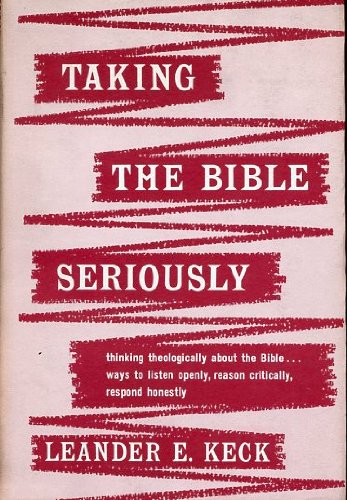
Here is a bit from one of his very early books on his theological approach to the Bible called Taking the Bible Seriously. It is basically an attempt to maintain some authority for the Bible while giving full reign to historical criticism. Here is what he says in a brief aside on textual criticism:
It is amazing how fundamentalism* talks so confidently about the inerrant, perfect, infallible character of the original Autographs of the Bible when no one has seen one for more than eighteen centuries! Moreover, it is clear that originally no one thought the wording was perfect since copyists, translators, and authors had little fear of changing it. This is one reason the text critic’s task is so complex. He aims to unravel these changes in order to provide a text which is reasonably reliable. He has no perfect text to offer (pp. 56–57).
I don’t have much to say on this since we’ve discussed inerrancy plenty on the blog and Keck isn’t saying anything that Warfield hadn’t addressed in his day (see here). I quote it here as just another example of the objection.

———
*In a footnote, he explains: “In this essay, the term ‘fundamentalism’ is used loosely to characterize right-wing Protestantism in general. The term has a checkered history.” From there he goes on short description of the history of the Fundamentals and mentions “more sophisticated” fundamentalists who are fleeing the term. He mentions those involved with Christianity Today and Inter-Varsity Fellowship and concludes, “Recently, conversation has been resumed between sophisticated fundamentalists and the other wings of Protestantism; this is clearly a good omen.” (He doesn’t say who or what it is a good omen for.)

Thursday, May 05, 2016

Warfield’s Review of Westcott & Hort

10
Princeton Seminary has put their old journals online. These go back to 1825 with the Biblical Repertory. There are plenty of essays from the bright lights of Old Princeton. Among the articles is Warfield’s 32-page (!) review of Westcott and Hort’s GNT.

The PDF is available at https://commons.ptsem.edu/id/presbyterianrevi3101unse-dmd007. Here’s a great diagram offered as an illustration of WH’s genealogy of the NT text (p. 340):

Update

Yesterday I also came across some of Warfield’s reviews of Burgon, Scrivener, Kenyon, and a few others. These are from a 1932 reprint. You can download them here.

Tuesday, November 01, 2005

Influence of Warfield

6
In the comments to an earlier post on Heroes of NT Textual Criticism (no, you haven’t missed the rest of the series, they are still, as they say ‘in preparation’) the question was raised as to whether B.B. Warfield should be regarded as an influential evangelical NT textual critic.

“Peter” was rather dismissive:
Well in my view, Warfield did nothing significant in the field of textual
criticism. Perhaps he did clarify some points of evangelical theology in
relation to the original text, but that was nothing new.
P.J. Williams was rather more positive:
I would agree that Warfield did little by way of research within textual criticism. However, he has had a profound effect on attitudes to textual criticism in the current evangelical constituency. ... If we look at effect on church constituency then Bengel, Warfield and Burgon seem to me to have had the biggest effect ...
Challenged to provide more evidence on this he wrote:
Measuring Warfield’s effect is very difficult, since even if he had published nothing on textual criticism it is certain that many within his constituency would have reached the same conclusions that he did. However, Warfield was the premier theologian of the early twentieth century among the Reformed evangelical constituency, and his favourable, though qualified, acceptance of the scholarly consensus of his day as far as textual criticism was concerned undoubtedly would have persuaded many minds against a more reactionary stance. There is discussion about the relationship between Warfield and the popularity of the doctrinal qualification of the scriptures as ‘inspired as originally given’ (or similar formulations). I haven’t done my homework to see how much is in this.
Well, all that is interesting background to my discovery today of A.T. Robertson’s book, An Introduction to the Textual Criticism of the New Testament (London: H&S, 1925).
Robertson dedicates his book ‘To the Memory of B.B. Warfield’ and describes the great help he had received from Warfield’s book (of the same title) until it went out of print. He tried to get Warfield to revise it, but Warfield refused on the basis that he was teaching Dogmatic Theology. ‘No one else outside of Hort ... had so clearly and fully set forth the principles of textual criticism that the student could readily grasp the science and apply it.’ Then he says that Warfield had urged him (i.e. Robertson) to revise the book. Which eventually he did, although in the end he had to write a new book.
So there is some evidence of the influence of Warfield on someone holding a similar position on Scripture (not presumably on other subjects since Robertson was a Southern Baptist, so no dancing), and who was a rare example of an evangelical scholar engaging in the scholarly endeavour.
PS. There is a rather interesting comment in the preface:
My task would have been greatly simplified if Gregory had carried out his purpose of preparing a new edition of Tischendorf’s Novum Testamentum Graece (1869) instead of going to the front and losing his life.
He continues:
That was a fine exhibition of patriotism for his adopted country (Germany) on the part of a man of seventy, but not the least of the tragedies of the world war.
He later says that he cherishes the hope
‘that some one who reads these words may take up the task that Gregory dropped and carry it on to completion.’
Enough already
Peter