Showing posts with label Anthony Ferguson. Show all posts

Thursday, April 10, 2025

A Less Studied Isaiah Scroll

4
In my own personal study of Isaiah, I’ve come across a less known and less studied Dead Sea Scroll, 4QIsao (4Q68), that preserves some insightful, even peculiar details. It dates paleographically to 100-50 BC which makes it a little younger than the more popular 1QIsaa.

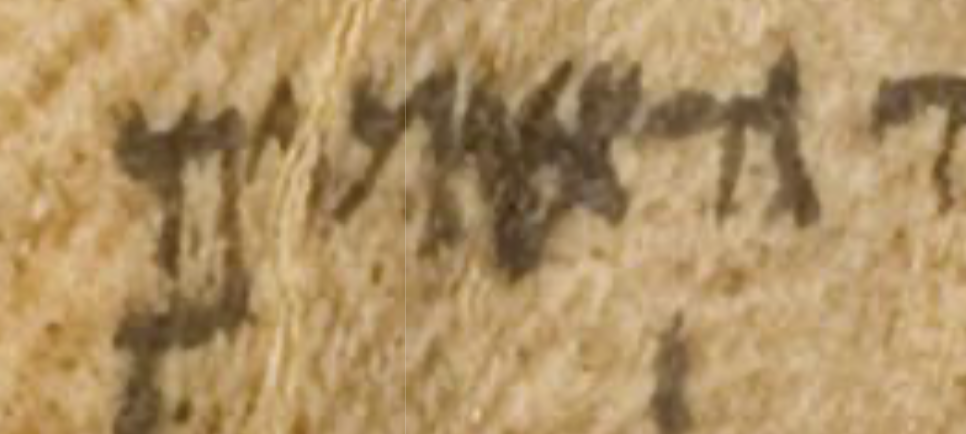
In this photo of 4QIsao, you’ll notice several yellow underlines, two red underlines, and one blue underline. Seven yellow underlines draw our attention to some peculiar uses of a final mem used in non-final position. From my experience, this feature is seldom evidenced in the Dead Sea Scrolls. Has anyone seen a comparable text?

The red underlines refer to two orthographic variants. In these two instances, the scribe of 4QIsao transcribes the more common form of “night” לילה for the MT’s less common form ליל. The difference here regards spelling and that of only one letter – a heh – and probably represents a facilitating approach to copying the text since the form of 4QIsao is the more common spelling.

Finally, the blue underline draws our attention to an ancient textual variant. Here is a breakdown of the textual evidence in MT, 1QIsaa, and 4QIsao.


MT (Isa 14:31)

1QIsaa (Isa 14:31)

4QIsao (Isa 14:31)

וְאֵין בּוֹדֵד בְּמוֹעָדָיו

And there is not one who separates in his ranks

ואין מודד במודעיו

And there is not one who measures (out punishment) for his kinsmen 

ואין] בודד בםידעיו

And there is not] one who separates among his friends


The witnesses are all genetically related and concern three interchanges: 1) interchange of bet (MT/4QIsao) and mem (1QIsaa), 2) interchange of vav (MT/1QIsaa) and yod (4QIsao), 3) and transposition of dalet and ayin (MT vs. 1QIsaa and 4QIsao). Each of these interchanges is common in the Jewish Square Script. The MT is probably the more original reading with the two Dead Sea Scrolls trying to make sense of the MT’s difficulty. The difficulty of the MT is further evidenced in the Septuagint’s confused translation of καὶ οὐκ ἔστιν τοῦ εἶναι. Since at least the second century BC, the difficulty of the MT appears to have puzzled scribes and translators. 

Overall, this manuscript stands out for its peculiar usage of final mem in non-final position, a feature that marks it as exceptional among Dead Sea Scrolls. The rest of the scroll is typical for Qumran texts, fragmentarily preserving a biblical text that aligns very closely with Codex Leningrad, matching it at 97.77% when excluding two spelling differences. While it contains one insightful textual variant at Isaiah 14:31, this variant appears to interpret the MT in light of its context. In a small but meaningful way, 4QIsao affirms the fidelity of the Masoretic tradition. Its text is nearly identical to it, and when it diverges, it does so in predictable ways.  

Wednesday, March 12, 2025

Correcting a Dead Sea Scroll

5
Correcting a digital text today is simple and neat. I simply highlight the text to be deleted and press my “delete” button on my keyboard. When I notice a mistake right away, I can simply press the undo button to erase my last input. The phenomenon of simple and neat corrections is a modern reality, not an ancient one. In this post, I’d like to highlight some techniques scribes used to correct the biblical text. 

Deleting Text
When ancient scribes deleted text, they could use “cancellation” dots. Both examples below come from 1QIsaa. The second picture is quite peculiar since the initial scribe corrected the text, making the verbal stem explicitly qal, only for the same scribe or a future scribe to delete the correction with dots. The result of the cancelation dots is the verbal stem once again becomes niphal.
Scribes could cross out the material to be deleted. Here is an example from 1QIsaa.
Another option was to bracket the content in parentheses. Here is a partially extant example from 11QpaleoLev. Only the final bracket is preserved.

Scribes could also scrape the ink off the writing surface (i.e., erasure). The scribe of 1QS often resorts to this technique.
Adding Text
By far, the most common way to add originally omitted text was with a supralinear correction (i.e., adding the material above the line). This type of intervention is common, especially in 1QIsaa

Substituting Text
Scribes often needed to correct the text by substitution. They could do this by combining the features above such as cancellation dots plus a supralinear correction. Reshaping an errant letter was another option. This technique often resulted in recognizable but peculiar letters. Here are two examples from 1QIsaa.

This second example is especially important since the reshaped letter is probably an aleph. Most likely the scribe was in the process of written ארצ (with a non-final sade) based on the context but realized his mistake and corrected the text to read השמים.

Correcting ancient manuscripts could get messy as these above examples prove. It is important that textual critics and those concerned with the transmission of Bible remind ourselves of this reality. What is easy and neat for us, was not always neat for ancient scribes copying the Bible. 

Tuesday, February 18, 2025

Appreciating 11Q5: A Comparative Look at the Great Psalms Scroll

1
11Q5 (11QPsa), known as the Great Psalms Scroll, is on display at the Ronald Reagan Library in Simi Valley, CA. This exhibition has been made available by the Israelite Antiquities Authority and the sponsorship of The Lowell Milken Family Foundation. You can learn more about the exhibition here. I had the opportunity to visit the exhibit on Friday with my family and found it to be an enriching experience.

In this post, I’d like to discuss three (among many!) important features of this manuscript by way of comparing it to the more popular 1QIsaa. For a discussion on the textual nature of the manuscript, see my prior post here.


1) Writing Precision and Formatting
One of the most noticeable differences between 1QIsaa and 11QPsa is the approach to the writing block. A writing block is the rectangular shape created by the top and bottom horizontal lines and the right and left vertical lines (See Tov’s Scribal Practices pp. 82-108). The scribe of 11QPsa writes within the writing block while the scribe of 1QIsaa often transgresses it. Notice that the scribe of 11QPsa only goes beyond the left vertical line twice in col 7.


Compare this column to column 2 of 1QIsaa. Here the scribe transgresses the left vertical line in almost every line.


The lack of concern for the writing block is perhaps most pronounced where the scribe begins a word to the left of the vertical line. Although only one letter of the word remains (due to deterioration of the manuscript), the letter is clearly to the left of the writing block and the beginning of a new word. See an example of that here.


Similarly, sometimes the scribe of 1QIsaa begins a word and realizes he cannot complete it in the remaining space. In these instances, the scribe has recourse to some “less than ideal” procedures. For example, here he begins a word, realizes he cannot finish it, stops, and transcribes the word in its entirety at the start of the next line.


In another situation, the scribe crams the final portion of the word (a pronominal suffix) above the line.


This feature of writing in the writing block reflects to some degree the skill of the scribe. The scribe of 11QPsa was more skilled than the scribe of 1QIsaa, at least regarding the spacing of words.

2) Degree of Scribal Intervention
Both manuscripts display a different level of scribal intervention. 1QIsaa has an instance of scribal intervention every 4 lines while 11QPsa has an intervention every 9 lines. (See again Tov's Scribal Practices, pp. 332-335). Neither statical is very impressive to be sure. 

A brief survey of the columns indicates that the scribe(s) of 1QIsaa intervened in the text much more frequently than the scribe of 11QPsa. Here is a column from each respective manuscript for review.


3) The Paleography
The paleography is also different. Although not uncommon among biblical manuscripts, it is exciting to see the divine name written in paleo-Hebrew in 11QPsa rather than the Jewish-Aramaic Square Script.

Next, the script is clearly from different eras. Some features of 1QIsaa include inconsistent use of final letter forms in final position (and even final letter forms in non-final position). The letter forms of 1QIsaa are not consistent in size. The script of 11QPsa, however, uses final/non-final letters and represents the letter size consistency. Here are some specific letters for comparison.

See the different form of the samek. In 1QIsaa, the form is open at the bottom.


See the different size of the ayin. In 1QIsaa, the form is more truncated.


Notice the backyard tick at the top of the zayin in 11Q5. It is more pronounced than in 1QIsaa (usually).


Notice the length of the downward stroke of the yod and the nature of the letter's head. The letter form is longer and more angular in 11QPsa.


There are several fascinating features of 11QPsa. These are just three. I hope this post stimulates more work on this important manuscript and readies visitors for their visit to the Reagan Library Your visit will not disappoint.

Wednesday, January 29, 2025

1QIsaa and Shifting Categories

3
Sean McDowell and I recently had a conversation about 1QIsaa. You can access the conversation here: https://www.youtube.com/watch?v=90_Mpiz1ons&t=333s

I repeat some of my points here along with some pictures! I hope you enjoy. 

1QIsaa is the most popular Dead Sea Scroll. It was one of the initial six (or seven) manuscripts discovered (see Weston Fields’ Full History for a helpful overview of the discovery), and it is a copy of the book of Isaiah: a very important OT book. Additionally, the text is ancient. Although many antiquity dealers and scholars initially assessed it as medieval or a modern forgery, paleographic and radiocarbon dating have vindicated the impression of Mar Samuel (a Syriac Archbishop who purchased it from the Bedouin), the keen analysis of Eleazar Sukenik, and the conclusions of Brownlee, Burrows, and Trever at ASOR (now the Albright Institute of Archaeology). The scroll is ancient. The paleography is, more precisely, Hasmonean. Features of this script include non-uniform letter size, inconsistent use of final letters, and the often non-ligatured consonant combination of nun-yod/vav (see the end of this article for pictures illustrating some of these features).


Many of us are aware that this text’s fame has recently been revived because of Wes Huff’s thrilling and helpful interview with Joe Rogan. Unfortunately, that conversation has stirred some controversy regarding the description “word-for-word”. I aim to provide some background information on this discussion, hoping it will bring greater clarity to this important topic.

Past Assessment of 1QIsaa: Wes Huff’s point that 1QIsaa’s alignment with the MT shocked those who initially studied it is true. Kutscher makes this point on page 2 (see also footnote 6) of his monumental work The Language and Linguistic Background of the Isaiah Scroll (1QIsaa). These first scholars were not ignorant to the textual variants preserved in this text. They understood the text’s divergent linguistic profile and were also fully aware of the large-scale differences. Yet, the general assessment of the first generation of scholars who analyzed this text was that this text is a popular edition of a proto-Masoretic text.

Present Assessment of 1QIsaa: Although those initial scholars emphasized the text’s alignment with the medieval MT, modern scholars tend to emphasize the text’s differences. This change in attitudes is not the result of a new discovery or the realization of new textual variants. Rather, the change coincides with a shift in OT textual criticism away from analyzing the “quality” of the variant to stressing the “quantity” of the variants. In short, the grouping of OT manuscripts has become much more precise over the last thirty years.

When the Dead Sea Scrolls were discovered, the local text theory of Albright was the dominant theory regarding the transmission of the OT text. This theory grouped manuscripts, all manuscripts into three broad categories. We could refer to these groups as text-types. The Dead Sea Scrolls were born into this framework, so initial scholars sought to take each text and put it into one of these three categories. Most non-textual critics may be unaware that textual critics have largely abandoned the local text theory now. Scholars have replaced the local text theory of Albright and Cross with a variety of frameworks that do not restrict a text into one of three categories based on its alignment to MT, SP, and LXX. Emanuel Tov’s framework is the most popular alternative to the local text theory (but there are others). Tov postulates four broad categories: proto-MT (and semi-MT), pre-Samaritan, texts close to the Vorlage of the LXX, and non-aligned texts. Three of these categories align closely with the categories of the local text theory. The non-aligned category is the additional category. In one sense, this category has freed scholars from grouping texts, including 1QIsaa, into one of the three categories of the local text theory.

This present confusion is, at least in part, the result of this shift in methodology.

Analysis of the Methodological Shift: Categorizing manuscripts has become more “quantitative” than “qualitative”. Whereas Leitfehler (i.e., indicative errors) used to be the rule in grouping manuscripts (that is a “qualitative” approach), now the entire text is considered including unique readings and minor differences of orthography and morphology (this is a “quantitative” approach). This latter approach to textual criticism has its benefits. For example, it clearly demonstrates that scribes of the Second Temple period possessed the freedom to update a text’s orthography, morphology, grammar, and syntax. Moreover, it helps scholars see that many of the Dead Sea Scrolls do not align with Codex Leningrad to the extent that the medieval manuscripts. These are two important benefits of the new methodology.

However, the modern approach to classifying texts can also be confusing as we are witnessing firsthand today. The main drawback of this new method is it does not depict or describe the “significance” of the variants. In other words, the new method does not weigh variants, but counts them. Although this has its benefits as just mentioned, it also skews the opinions of both non-specialists and the specialists. How significant are these variants? The new methodology largely cannot answer this question. Thus, we have confusion abounding. So, how should we understand the differences between 1QIsaa and the MT?

For a deep dive into this question, variants must be weighted, not merely counted. You can see my dissertation where I do both. Donald Parry’s book Exploring the Isaiah Scroll and Their Textual Variants is another fantastic resource that assesses the significance of the variants. In have grouped the variants into three categories:

1) Some variants (thousands!) merely represent a “facilitating” approach to copying. At times, the text’s spelling, morphology, grammar, and syntax have been updated to fit contemporary usage.

2) Many variants (about 900) between 1QIsaa and the MT represent a change in meaning. Most of these changes, however, are the result of common scribal tendencies. These variants include unintentional changes (i.e., scribal errors) and intentional ones that often result in an interpreted or harmonized text. When comparing the texts, the texts are not synonymous, but common sense often reveals that the two readings are genealogically connected. One derived from the other.

3) Finally, the text preserves about 30 variants that do not result in a synonymous form (the first set of variants) nor is there an immediate scribal explanation that accounts for their genesis (the second set of variants). This final fact should not alarm us. Copying an ancient manuscript is a difficult task. While we have the luxury of powerful tools such as word processors and internet search engines, ancient scribes did not. Before becoming too critical of the scribe of 1QIsaa, we should imagine the difficulty of his task. I’d rather write a text today in the comfort of my office on my powerful computer than in an ancient room with parchment and a reed pen.

Our present confusion, then, is in part the result of a shift in methodologies. As Wes Huff stated, it is also the result of a mistake on his part. 1QIsaa should not be described as “word-for-word” identical to Codex Leningrad. At the same time, we should not exaggerate the differences as Kutscher states 50 years ago.

I hope this provides some background on why conflicting categories for 1QIsaa have emerged while providing a more balanced assessment of 1QIsaa’s textual character.

For those who enjoy pictures, here are some pictures illustrating some of the above phenomena of the manuscript. See http://dss.collections.imj.org.il/isaiah for the digital image of the manuscript from which I took these pictures.

Notice the peculiar use of a final mem in non-final position and the inconsistent height of the letters in the image above. The kaph extends here closer to the baseline than the shin. (http://dss.collections.imj.org.il/isaiah).

See above the more common occurrence of a non-final mem appearing in final position.


Notice the plene spelling here, a very common feature of 1QIsaa. (http://dss.collections.imj.org.il/isaiah).


In this above image, there is a peculiar example of a nun formed by a scribe who did not lift his pen between the gimal and nun. This "cursive" feature causes the nun to appear as a gimal.

Friday, February 09, 2024

Scribal Habits in Near Eastern Manuscript Tradition and the Dead Sea Scrolls

0
I recently read and reviewed Scribal Habits in Near Eastern Manuscript Traditions for the journal, Presbyterion, published by Covenant Theological Seminary. I thought an overview of the book and some of my takeaways as an OT textual critic studying the Dead Sea Scrolls might be helpful here. To purchase the book with a 40% off coupon, use this code generously provided by the publishers: SH40%

https://www.gorgiaspress.com/scribal-habits-in-near-eastern-manuscript-traditions


Overview: The paratextual elements of Near Eastern manuscripts are the focus of Scribal Habits in Near Eastern Manuscript Traditions. These elements, such as annotations, colophons, illustrations, diacritical signs, and commentaries are often overlooked by those interested in biblical studies because of an emphasis on a manuscript’s main literary text. This tendency is understandable given evangelicals' commitment to the text of Scripture but neglecting these paratextual elements ultimately obscures a fuller and more complete understanding of these manuscripts and the texts they transmit. This book, Scribal Habits, highlights these features to provide readers with the ability to ‘“virtually look over the scribes’ shoulder” (xiii; a slight rephrase of the words of J. R. Royse).

Here is a sampling of the book’s content. Elizabeth Buchanan concluded in her chapter that the use of the diaeresis in Byzantine Egypt evinces patterns. One of these patterns is that the “more accomplished writers” used the sign most consistently (23). Binyamin Katzoff studied the chapter divisions in the Tosefta and concluded that the divisions in the E tradition corresponded with the divisions of the Mishna. This study provides insight into how one tradition could be influenced by another literary work: in this case, the Mishna (102). Katzoff’s second chapter of the book investigated how a text could be systematically corrected to a text of an alternative textual tradition (112). This summary suffices to show the importance of these features, especially for evangelicals when studying biblical texts. Our assessment of the biblical text has to consider these features. 

Application to OT Textual Criticism: As a biblical scholar, in particular, a textual critic primarily concerned with the Dead Sea Scrolls, two topics of this book intrigued me. First, I was interested to learn about the significance of the paratextual elements in Near Eastern manuscripts since several of these elements are also present in the Dead Sea Scrolls. For example, diacritical signs are used in some manuscripts such as the margins of 1QIsaa and 4QCantb, 1QIsaa may preserve a marginal gloss, and a drastic shift in paleography occurs in 4QJosha. Moreover, there is a shift from poetry to prose in 11QPsa. Given the use of these features in the Dead Sea Scrolls, I was interested in how these paratextual elements functioned in other texts of this region.

Second, I hoped that this book would help me ask different questions about the Dead Sea Scrolls and open new avenues of study for me. This task is comparative. That is, I hoped to compare these mostly later more extant manuscripts and their signs and features to the earlier less extant Dead Sea Scrolls.

Before I engage in this comparative task, it is helpful to mention a few difficulties with this process. Perhaps the most profound difficulty in comparing these later Near Eastern manuscripts to the Dead Sea Scrolls is that the Dead Sea Scrolls exist in a highly fragmentary state. Anyone familiar with this discipline understands this reality, and it can easily be illustrated by turning to the back of a DJD volume and observing the PAM plates. One can also see this reality by exploring “The Leon Levy Dead Sea Scrolls Digital Library” accessed here https://www.deadseascrolls.org.il/home. Many Dead Sea fragments are unidentified, and some are only probably identified (see the debate around 4Q118, for example). This reality complicates an investigation into the paratextual elements of the Dead Sea Scrolls since many upper, lower, and intercolumnar margins have decayed. Handle sheets, title pages, and the endings of most manuscripts have deteriorated into dust. What precious information that these columns of parchment once contained is now lost, regrettably so, so that scholars can only dream of what a now lost colophon might have contributed to our understanding of these manuscripts.

Another difficulty with this process is the chronological and cultural gap between the Scrolls and the texts analyzed in Scribal Habits. For example, the Dead Sea Scrolls are usually earlier than the manuscripts discussed here although there is at least one exception to this (see Szilvia Sövegjártó’s chapter on the Sumerian texts from the Old Babylonian era). Scribal habits, and the paratextual elements that they utilized, may not have remained static. The same can be said of the cultural differences between ancient Jews and the cultures of the scribes who preserved the manuscripts discussed in Scribal Habits. These realities, likewise, might complicate the comparative task.

Despite these difficulties, I did enjoy comparing these texts to the Dead Sea Scrolls. Here are some thoughts regarding one of the chapters. T. C. Schmidt discussed the reception history of the Book of Revelation in Eastern churches, and in particular, the scribal strategies that might indicate a scribe's general assessment of the book. For example, the material used for writing, the books to which Revelation was bound, and the writing style of the scribe were all strategies that might demonstrate the scribe's attitude about the book’s status.

These insights provided me with interesting questions to ask of the Dead Sea Scrolls such as Does the quality of the script have any effect on a book’s status? Is there any connection between expertly copied texts and the status of the texts preserved in these manuscripts? Here I am thinking of what Tov labels de luxe edition manuscripts (see Scribal Approaches, 125-129). What does the phenomenon of stitching biblical and nonbiblical texts together signify about these texts’ status? This question continues to be an important issue regarding 11QPsa. Although most of the Dead Sea Scrolls are copied on parchment, what does the use of papyrus signify if anything during the Second Temple period? This distinction was significant in rabbinic literature. Is there a correspondence between the orthographic profile of a manuscript and the manuscript’s paleographic style? This one chapter demonstrates the importance of Scribal Habits for those interested in the history of ancient manuscripts including manuscripts that preserve the biblical text.

Overall, Scribal Habits was an enjoyable and insightful read, and it rightly stressed the importance of these paratextual features. Going forward let's open our eyes to the margins of the manuscripts, and let's get excited about what we might see. 

Friday, March 10, 2023

Emanuel Tov and His Evolving Categories for the Biblical Dead Sea Scrolls

7

Emanuel Tov is the most well-known textual critic of the Hebrew Bible and for good reason. Under his leadership, thirty-three volumes of the authoritative series Discoveries in the Judaean Desert (DJD) were published in less than twenty years. Before his tenure, only seven volumes were published in nearly forty years. Despite this impressive feat, Tov is probably most well-known for his work Textual Criticism of the Hebrew Bible.

The book is now in its fourth edition, and it is the go-to work for those interested in textual criticism of the Hebrew Bible. One aspect of the fourth edition, among many, worth discussing is his categorization of the biblical Dead Sea Scrolls. A comparison of these categories across his four editions shows a certain evolution in how he views the text of the Hebrew Bible in the Second Temple period.

First Edition (pp 114-117)
QSPProto-MTPre-SamClose to Hebrew of LXXNon-Aligned
20%60%5%5%10%


Second Edition (pp 114-117)
QSPProto-MTPre-SamClose to Hebrew of LXXNon-Aligned
20%35%5%5%35%


Third Edition (108-110)
Torah
Proto-MTPre-SamClose to Hebrew of LXXNon-Aligned
48%11%2%39%


Rest of Scripture
Proto-MTClose to Hebrew of LXXNon-Aligned
44%7%49%


Total
Proto-MTPre-SamClose to Hebrew of LXXNon-Aligned
45%5%5%45%


Fourth Edition (pp 135-136)
Torah
Proto-MTMT-SP BlockPre-SamClose to Hebrew of LXXLXX-SP BlockNon-Aligned
2%28%9%2%27%32%


Rest of Scripture
MT-LikeMT-LXX BlockClose to Hebrew of LXXNon-Aligned
22%16%5%57%


Total
Proto and semi-MTMT and LXX BlockMT-SP BlockPre-SamClose to Hebrew of LXXLXX-SP BlockNon-Aligned
13%9%13%4%4%12%45%


Observations
Observation #1: The category, Qumran Scribal Practice, was a group of texts united by a distinctive orthography and morphology. These texts, however, did not share a textual background, so Tov eliminated this category in his third edition (see 3rd ed., 110). The elimination of this category caused the non-aligned and proto-MT categories to increase by 10% each.

Observation #2: The statistics of the proto-MT category and the non-aligned category have changed most drastically. Tov has not been completely clear on the qualifications for the categorization of these manuscripts. For example, he describes a non-aligned text as one that is “not exclusively close to MT, LXX, or SP.” They are inconsistent in aligning with MT, SP, and LXX while preserving unique readings (3rd ed., 109). This description of the non-aligned category lacks precision. At what point does a text morph from being proto-MT or MT-like to being non-aligned?

Despite this lack of precision, it is clear that Tov’s proto-MT, and even his semi-MT, categories are restrictive categories. For a text to fit into these categories, a text must align closely with the MT even regarding its orthography. If a text deviates orthographically from the MT, it most likely becomes non-aligned as in the case of 1QIsaa. The opposite is true with the non-aligned category. It is by definition, extremely broad since these manuscripts are joined together not by a common denominator of shared readings but by the simple fact that they disagree with the other texts (MT, SP, and LXX). Over time, Tov’s proto-MT category has become more restrictive while the non-aligned category has become broader. This detail has led to a dramatic decrease in those texts labeled proto-MT texts and a dramatic increase in those texts labeled non-aligned.

Observation #3: A superficial survey of the above statistics shows that the fourth edition has more categories than the first three. The reason for this is that in earlier versions, texts that were equally close to the MT and SP were categorized as MT. Similarly, texts equally close to MT and LXX were understood as proto-MT (3rd ed., 108). The MT, however, in the fourth edition, is no longer the default text in the categorization of the biblical Dead Sea Scrolls. If a text agrees with the MT and the SP, it is labeled MT-SP. If a text agrees with the MT and LXX, it is labeled MT-LXX. Moreover, Tov now differentiates between proto-MT and semi-MT texts. Proto-MT texts are more closely aligned with the MT than semi-MT texts. Overall, the addition of more categories has led to a further decrease in those texts labeled proto-MT.

Observation #4: Since 1992, more manuscripts are included in Tov’s statistics. For example, Tov understood 4QRPc-e (Reworked Pentateuch) to be non-biblical in the first two editions, but beginning in the third edition, these manuscripts are categorized as non-aligned. The statistics in the fourth edition also include seventeen tefillin that do not seem to have been included in the statistics for earlier editions. Although tefillin are technically non-biblical texts (they are excerpted texts), Tov now includes them in his categorization grid. These details, likewise, have shifted the statistics away from the proto-MT and semi-MT categories.

Tracing the Evolution
Overall, the evolution of the biblical Dead Sea Scrolls in Tov’s categorization grid moves away from proto-MT. The steps contributing to this movement included the increase in categories, the increase in texts now included in the statistics, and the understanding that the MT is no longer the default text in his categories. The elimination of the QSP category led to an increase in the proto-MT category in the third edition, but this type of change has been the anomaly. The evolution of Tov's categories is rather straightforward: for Tov, fewer texts are proto-MT, and more texts are now non-aligned. 

Friday, September 24, 2021

Hebrew Scribes at the End of the Line

9
Composing a text by hand demands an awareness of certain details that we can ignore when using a word processor. One of these details is if the next written word corresponds to the available space. At times, the space didn’t for Hebrew scribes, and when this happened, they had several ways to navigate this situation. Let’s review some of these. For more information on these practices, see Tov’s discussion in chapters 4 and 5 of his book Scribal Practices. This list depends on and derives in part from his helpful discussions.

First, scribes could utilize the margin to finish the word. This practice is not uncommon. Here is a portion of column 2 of 1QIsaa illustrating this practice.


Second, a scribe could fill in the remaining line with space fillers. The scribe of 1QIsaa resorts to using dots in 1QIsaa Col 3:6.


Third, a scribe at times began a word at the end of a line but didn’t finish it. Instead, the word was written in full at the beginning of the next line. Here is an example from 1QIsaa Col 2:11.


Fourth, it is possible that the scribe of 1QIsaa began a word and simply failed to finish it. See 1QIsaa Col 6:3.


Fifth, a scribe might begin a word at the end of the line and complete it on the next line. Tov states that this was a practice of scrolls written in paleo-Hebrew. 11Q1 Col 3:5, 6, 7 are examples of this.


Sixth, a scribe might resort to a smaller “font-size” to fit the word in the available space. See 1QIsaa Col 16:30 (the first line in the photo below).


Seventh, a scribe might write part of the word above the line. Here are some examples from 4QPsx.


Eighth, a scribe might cram words together leaving little space between the words. This tendency is common in 4QPsx and here in 1QIsaa Col 16:24.


Ninth, a scribe might leave bigger spaces between letters as here in 4QDeuth 1:5–7. Tov labels this device “proportional” spacing. 


These pictures were taken from photos found at the Leon Levy DSS Digital Library and the DSS Digital Project.

Monday, December 21, 2020

4QPsx: A Poorly Copied Manuscript

4
Several details about the Dead Sea Scrolls are common knowledge. One of these details is that these manuscripts preserve a certain level of textual plurality previously unknown among Hebrew OT manuscripts. Although this detail is a fact, the nature of this textual plurality is mostly unknown by laypeople and scholars alike. We should be aware that common explanations explain most of this textual plurality. One of these explanations is poor copying. (In a previous blog, I discussed that some of this diversity results from scribes normalizing their biblical texts [such as 4QGenk]).

4QPsx is one manuscript, among many, that was copied poorly. Interestingly, some scholars date this manuscript, which preserves portions of Psalm 89, to 175-125 BC. If this is right, this manuscript is our earliest manuscript available that preserves a psalm; yet, it is an unreliable guide to the Psalter's state, and Psalm 89 in particular, during the second century BC. Several details about this manuscript suggest that this scribe was either an unskilled or a beginner scribe. Varying letter size, inconsistent space between lines, curved lines, cancelation dots to erase a mistake, inconsistent use of final letters, and the inability to space words properly are just a few of these details. (See Skehan’s article “Gleanings” for these and other points). 

4QPsx: https://www.deadseascrolls.org.il/explore-the-archive/image/B-473784

Besides these scribal features, we should consider several other material features of this manuscript that call into question its dependability. This manuscript is unruled, and this reality contributes to some of the mistakes listed above. Indeed, the absence of a writing block made it challenging to space the words, and the lack of horizontal lines caused the scribe to write upwards and downwards at times. The fact that this manuscript is unruled is puzzling since most manuscripts at Qumran were (see Tov, Scribal Practices, 57, 104). More puzzling is that this manuscript was stitched before inscribing these words, which, again, is unusual (Scribal Practices, 34-37). This fact is evident since the scribe wrote around the stitching (“Gleanings,” 441). Thus, these two details suggest that this sheet of leather was previously a handle sheet (a protective piece of leather stitched unto inscribed sheets at a manuscript's beginning and/or end).

The scribal habits and the material features of this manuscript cast serious doubt on the text's reliability. Although some might understand this text as an alternative form of Psalm 89, I suggest that it is a recycled handle sheet (like Skehan): perhaps a scribe's school exercise. Overall, this text contributes to the textual plurality preserved at Qumran but provides no evidence to suggest that the OT existed in a state of fluidity during this time (fluidity meaning that the text had not yet reached its final form). Instead, this manuscript suggests that some manuscripts were copied poorly and, perhaps, some manuscripts are mere school exercises. As already noted, this manuscript may be our earliest manuscript preserving a psalm. This reality reminds us of a vital point of textual criticism: the earlier manuscript is not always better.


*For more information about this manuscript, see my dissertation, A Comparison of the Non-Aligned Texts of Qumran to the Masoretic Text. It can be accessed on ProQuest. You may also view the presentation that I gave at the Sacred Words Conference, where I discuss this manuscript in more detail. 

Wednesday, July 29, 2020

4QGenk: A Normalized Manuscript

20
4QGenk (4Q10) is a poorly preserved manuscript that contains 70 partial words. Among these partial words, there exist three variants (I am not counting differences of plene/defective spelling here). Each of these variants all function to replace an uncommon grammatical form of the MT with the more common form. This common denominator suggests to me that scribe of 4QGenk has taken liberties with his exemplar, or perhaps the scribe has copied from a manuscript that has taken these liberties, to normalize the grammar of the MT. 
Variants between MT and 4QGenk
Fragment, Line, and Verse
4QGenk
MT
F1:L1 (Gen 1:9)
ותרא
And let it appear
וְתֵרָאֶה
And let it appear
F2:L3 (Gen 1:14)
ולש֯[נים.  ]
and fory[ears]
וְשָׁנִים
and years
F5:L2 (Gen 3:1)
האף֯
Did…really
אַף
Really…

The difference persevered at Genesis 1:14 concerns a preposition, but the difference is minor since the scribe is simply making the grammar of the MT explicit. In the MT, one preposition governs two nouns – “days and years.” Although a preposition can govern more than one noun in a sequence in biblical Hebrew (the reading of the MT), the more typical form is to repeat the preposition after each noun (see GKC §119hh). The scribe has replaced the uncommon form of the MT with the more common form.

The same explanation applies to the addition of the interrogative heh in 4QGenk at F5:L2 (Gen 3:1). Interrogative statements can be expressed in Hebrew by an added particle (4QGenk) or by intonation (MT [See GKC, §150a]). Although both forms are possible, interrogative statements are most often marked with an interrogative particle (see GKC, §150c). 

Finally, the fragmentary nature of this manuscript complicates a certain understanding of the last difference. What is certain at F1:L1 (Gen 1:9) is that 4QGenk reads ותרא while Leningrad reads וְתֵרָאֶה. 4QGenhas omitted the final heh of the verb ראה. The form of the MT is a jussive (a tense of volition), but the form is uncommon. The typical jussive of a third yod/vav is an apocopated form: that is, the final heh is lost. It is not surprising given the other two variants in this manuscript that the scribe of 4QGenk provides this form: the more common form.

Tov labels this manuscript as non-aligned, and this categorization may give the impression that this manuscript provides positive evidence that the OT text existed in a state of diversity without any unity. This impression would be wrong. Rather, this manuscript suggests, in my mind, the presence of a stable text existing alongside a diversity of texts. Moreover, this manuscript demonstrates that some of the textual diversity preserved in the non-align category is the result of scribes normalizing uncommon forms. This tendency does not suggest the absence of an authoritative text in the Second Temple period; rather it supports its existence. 

*For more information about this manuscript, see my dissertation, A Comparison of the Non-Aligned Texts of Qumran to the Masoretic Text. It can be accessed on ProQuest. You may also view the presentation that I gave at the Sacred Words Conference.