Thursday, December 22, 2022

Amalar of Metz on nomina sacra/orthography

11

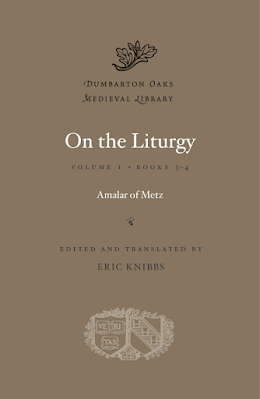
I was recently skimming through Amalar of Metz' On the Liturgy (specifically, volume 2) and came across an interesting couple of pages. Not only does Amalar write about the nomina sacra, he also gives a bit of precedent to questions about orthography reflected in the Tyndale House Greek New Testament.

Amalar wrote a letter "To his dearest father and most acute rhetorician, the prophet Jeremiah in our Jerusalem." The reference to Jerusalem threw me because at first, I was looking for a ninth-Jeremiah in Jerusalem, unsuccessfully. Eric Knibbs' notes on the text at the back of the volume identify this person as "Archbishop Jeremy of Sens (818–827)."

Amalar writes (Knibbs' translation, pp. 267–269):

Our countrymen write the name of our savior Jesus with the letter "H," and I am puzzled about the reason. I know that, if there is a reason that an "H" in Jesus's name is placed after the "I," it is not unknown to you. If you know, tell your son. If you do know, I am certain that it will be in the storeroom of your mind to pass the reason on to me. ... Now the Greeks write that name with the letters "I" and "C," and they read "Isus." Thus it seems to me—if it does not seem otherwise to you—that what we read as "Iesus" should be written with an "I" and an "H" and a "C" or an "S." I ask that you tell me with which letters I should write the stated name.

Jeremy of Sens responded and explained to Amalar that the letter was [and I am using lower-case here for clarity] not actually 'h' but 'η,' though they are written the same.

To be honest, I have wondered this too—why do we see IHS in the Latin tradition, which we still see today? I remember as a kid somebody in my rural southern church culture explained to me that he thought it meant "In His Service." I guess Jeremy's answer still doesn't really explain why we see the Greek eta in the Latin tradition, only that the 'H' is an eta. Has anyone come across any patristic/medieval discussions of why the Greek eta was used? If any of you, our readers, does know, I am certain that it will be in the storeroom of your mind to pass the reason on to me.

Wednesday, December 14, 2022

6 New Funded PhDs at Southeastern Baptist Seminary

1

I’ve been on sabbatical this Fall at Southeastern Baptist Theological Seminary in Wake Forest, NC. We head back tomorrow. While here, I’ve spent some nice time getting to know Chuck Quarles. Recently, he told me about plans for a new Center he was working on to study the text and translation of the Bible. I’m happy to share that, yesterday, the seminary made the formal announcement. From the press release:

The CBTT is designed to undertake three major initiatives: (1) to improve the quality of major English Bible translations, (2) to provide resources for Bible translators and translator consultants worldwide, and (3) to improve the quality of the critical editions of the Hebrew Old Testament and Greek New Testament. 

The center’s research associates will conduct research on various text-critical issues, indexing and transcribing ancient manuscripts of Scripture, writing textual commentary, investigating paratextual features, and developing tools to assist others in their research. An important function of the center will be resourcing and educating translators worldwide by making the center’s research and resources available for free online.

I particularly want to highlight the fact that the new Center has 6 fully-funded PhDs across the testaments. 

The center’s operational staff will include six research associates — one of whom will also serve as the center’s assistant director. Three of these research associates will be Old Testament and Hebrew specialists and three will be New Testament and Greek specialists. Research associates will receive full funding for their PhD studies at Southeastern; a stipend with benefits, including insurance; and free campus housing. Applications are open for fall 2023. To learn more or to apply, visit the Caskey Center for Biblical Text and Translation page.

If you are an aspiring evangelical textual critic, this looks like a great opportunity. The seminary has a beautiful campus, is in a great part of the country to live in, the student center here has Cheerwine on tap, and I can confirm that the library is well-stocked with NT text-critical resources (made a little better thanks to some book requests from yours truly!). And it’s a short drive over to Duke to look at their NT manuscript collection. Congrats to Chuck and good luck to the applicants!

Friday, December 02, 2022

Why I Cite Westcott and Hort’s Introduction As a Joint Work

0

It’s fairly common practice among text critics who have actually read Westcott and Hort’s famed Introduction to introduce citations from it as “Hort writes...” or the like. The reason for this is from p. 18 where, after acknowledging the benefits of their joint effort, we read: 

It was however for various reasons expedient that their exposition and illustration should proceed throughout from a single hand; and the writing of this volume and the other accompaniments of the text has devolved on Dr Hort.

Despite this note and despite the habit to cite the work as Hort’s, I have always cited it as the work of both. In my dissertation, for example, my first citation footnotes the following, “Although Hort is known to have penned this introduction, I refer to both authors throughout in order to reflect Hort’s concern that Westcott’s contribution to their thinking be represented” (Critical Examination, p. 36 n. 3). 


The reason for that is the letters that we have between them in which Hort was shocked to find that Westcott had apparently instructed the publisher to cut (or reduce?) Westcott’s royalties for the Introduction. Here is Hort’s initial letter and the reason why I insist on citing as I do. Hort even references the note on p. 18, which Westcott, in an earlier letter, had insisted on and approved in its final form.

To the Rev. Dr. Westcott
6 St Peter’s Terrace, Cambridge, Oct. 12., 1882

My dear Westcott,

A note has just come from Macmillan [their publisher] which distresses me much. It had never occurred to me that any question could arise as to a difference between the two volumes of our text in the matter of division of profits, and now that the question is raised, I fail to recognise the justice of the suggested difference. It is a mere accident that the Introduction and Appendix are disjoined from the text proper: till a few months before publication they were always intended to be included within the same boards, and to us at least the book remains one whole. But, apart from any considerations of this kind, the substance as distinguished from the form of Volume II is a join work, as simple matter of fact. That you entrusted me with the final redaction is an altogether subsidiary circumstance: What belongs to a part of the last two or three years must vanish in the sum of the twenty-eight. You last of all men should wish to make equality the true criterion of justice.

Nor indeed is it possible for me to forget that nothing but a difference in our scale of note-writing prevented you from contributing a large share of the Appendix; and it would be inexpressibly painful to me to be obliged to associate my acceptance of your withdrawal with such a result as you now propose. I cannot be too thankful for the generous way in which you have taken responsibility for the whole work (you must, I think, by this time be satisfied that the reference to my own special share at p. 18 has not escaped notice!); and it would be too grievous if there were a breach of solidarity now.

Ever yours affectionately
F. J. A. Hort
I’m not saying everyone else has to follow my lead. But since the two eventually agreed to split the royalties and Hort himself was pretty adamant that the work was both of theirs, I have chosen to honor Hort’s feelings on the matter in the way I cite it.

(The letter is from Cambridge University Library Add. MS 6597, letter 191)

Thursday, December 01, 2022

SCIO’s Workshop Logos 2023

0

SCIO's annual textual and Biblical studies' workshop Logos 2023 in Oxford is now open for applications.

Logos is designed to equip graduate and advanced undergraduate students in the fields of textual studies, Biblical studies, or a related discipline with the linguistic, textual, and critical thinking skills necessary for success in academia. The workshop also explores themes of public memory and Christian vocation.
 

Logos will be held in Oxford from 31 May – 14 June 2023. Participants receive a generous stipend, and all costs will be paid for. 

For more information and application form, see SCIO´s homepage.

Tuesday, November 29, 2022

Book Notice: Evangelicals and Digital Bible Use

2

I’ve just ordered the new book by John Dyer from OUP titled People of the Screen: How Evangelicals Created the Digital Bible and How It Shapes Their Reading of Scripture. John is a longtime evangelical and has been programming Bible software for years (for example). He’s also written a very well received book on the theology of technology. This new book is a version of his PhD thesis, I believe. I’m sure our ETC readers will be interested in this. Here is the description: 

People of the Screen traces the history of Bible software development, showing the unique and powerful role evangelical entrepreneurs and coders have played in shaping its functionality and how their choices in turn shape the reading habits of millions of people around the world. Examining advancements in Bible software from the first desktop applications to pioneering Bible websites, and later to mobile apps and virtual experiences, this book argues that evangelical creators have a distinct orientation toward societal change and technology called “Hopeful Entrepreneurial Pragmatism” that uniquely positions them to lead the digital Bible market, imbuing their creations with evangelical ways of understanding the nature and purpose of Scripture.

This book offers a blend of historical research, interviews with developers, and field work among digital and print Bible readers, offering a nuanced look at the interconnected ecosystem of publishers, developers, pastors, institutions, and software companies. Digital Bibles aren’t replacing print Bibles, author John Dyer shows. Rather, the future of Bible engagement involves readers using a mix of print, audio, and screens to suit their needs. He shows that sometimes the God of the page seems to say different things than the God of the screen, suggesting that we are still in the early stages of a multimedia approach to scripture.

I would also like to add that this is the first and only book cover I’ve seen that can appropriately use Verdana. It was designed for screen use and was one of the world’s most ubiquitous fonts for at least a decade. Please, publishers, do not use it for other books.

Tuesday, November 08, 2022

SBL Blog Dinner Denver 2022

8


Sun 20 Nov 7:00pm

The leadership of Trinity Church Denver have graciously agreed to host our annual SBL Blog dinner in their basement meeting space. $20 covers pizza, salad and drinks, which will be catered from Fat Sully’s NY Pizza and Walmart delivery. Many of our attendees will walk to the dinner from the NTTC “Methods and Criteria” section, which ends at 6:30pm. The walk takes less than twenty minutes.

Peter Head will provide humor and a brief devotion. Peter Williams will play the piano as we sing a couple of hymns. Attendance is open to anyone interested in the languages and transmission of the biblical texts regardless of your faith.

RSVP through Eventbrite and pay through PayPal.