Wednesday, July 29, 2009

SBL 2009 sessions announced

2
Access 2009 Program here.

NTTC, Saturday, 13:00–15:30

Peter M. Head: Vaticanus Distigmai
Matteo Grosso: Colossians 3:11
Gregory S. Paulson: Harmonizations in D in Matthew
Bill Warren: Spelling Tendencies of Scribes
James M. Leonard: Codex Schøyen, Alternative Gospel of Matthew


International Greek NT Project (John), Sunday, 9:00–11:30
Hugh Houghton: Chapter divisions in Old Latin John
Craig R. Koester: Use of Internal Criteria in Editing John
Rachel Kevern: Transcribing Manuscripts

TC of the Hebrew Bible (TC and Problems of Method and Interpretation), Sunday, 9:0011:30
Emanuel Tov: Latin, Aramaic, and Syriac Translations of Hebrew Scripture
Steve Delamarter: Textual History of the Ethiopic OT
Daniel O. McClellan: Anthropomorphisms and LXX Exodus
Andrew Teeter: TC and Legal Hermeneutics / Leviticus 17
Daniel Becerra: Ketib-Qere Readings and the Versions
John D. Barry: Digital Version of the BHS Apparatus

NTTC (Early Christian Literary Papyri), Sunday, 13:00–15:30
Thomas J. Kraus: Reconstructing Fragmentary Manuscripts
Dave Nielsen: Importance of New Testament Ostraca
Matthew V. Novenson: Marginal Annotation in the Papyri
Geoffrey Smith: Bodmer Miscellaneous Codex Community
Charles E. Hill: Diplai Sacra? [sic] / P.Oxy 3.405

Deuteronomistic History (TC of the Deuteronomistic History), Monday, 9:00–11:30
Eugene Ulrich: Composition, Redaction, and Textual Transmission
Martin Rösel: Deuteronomists in the LXX of the Historical Books?
Anneli Aejmelaeus: Textual Development in the MT of 1 Samuel 1 - 2
Julio Trebolle: MT and LXX in Kings

NTTC (The Two Bibles: The LXX and NTTC), Monday, 9:00–11:30
Leonard J. Greenspoon: “If I forget thee…: Remembering, and Forgetting, in ‘Scriptural Citations’ (20 min)
Martin Karrer: LXX Citations in their NT Versions
Kristin De Troyer: Quotations of "the Septuagint" in the NT
William Adler, Respondent

IOSCS, Monday, 13:00–16:00
Cameron Boyd-Taylor: Made from the Image
David Andrew Teeter: The LXX and Early Jewish Halakhah
Robert Hiebert: LXX Textual Research in the Early 21st century
John D. Barry: Using the Göttingen LXX Digital Version
Claude Cox: "Daughter Versions" of the Bible, Armenian Job

TC of Samuel – Kings, Monday, 13:00–16:00
Pablo Torijano: The Armenian Version of Kings
Elina Perttilä: Sahidic 1 Samuel
Tuukka Kauhanen: Early Church Fathers as Proto-Lucianic Witnesses
Julio Trebolle: Kings and LXX Grammar

NTTC (Textual Types of NT MSS: Emergence and Evaluation), Monday, 16:00–18:30
Holger Strutwolf: The Making of the Text-type Theory
J. L. H. Krans: Johann Jakob Wettstein
Dirk Jongkind: Samuel Prideaux Tregelles
Tommy Wasserman: Text-types and the Evaluation of Readings
Jared Anderson: Origen's Witness an Alexandrian Text
Klaus Wachtel: The Byzantine Text of the Gospels

TC of Samuel – Kings, Monday, 16:00–19:00
Christian Seppänen: David and Saul's Daughters
Dave Nielsen: Ketib-Qere Readings and the Versions
Philippe Hugo: The LXX of 2 Samuel

TC of the Hebrew Bible (Case Studies in Textual Criticism in the Prophets and Writings), Tuesday, 9:0011:30
Michael Langlois: Christian Palestinian Aramaic Version of Isaiah
Sunwoo Hwang: Intriguing Name-Changes in 2 Chron 13
Michael S. Heiser: LXX Enakim in Jer 47:5, 49:4
Eun Woo Lee: Textual and Literary History of Josh 3-4
Jean-Daniel Macchi: Why Haman became an Agagite?

Saturday, July 25, 2009

Rewriting the Bible in Postmodern Parallel

3
The apologist James White on his blogsite has called attention to the controversial publicly funded exhibit in Glasgow, "encouraging people to deface the Bible in the name of art" -- an exhibit which features a copy of the Authorized Version, "a container of pens and a notice saying: 'If you feel you have been excluded from the Bible, please write your way back into it.'"

The results of course have been almost exclusively negative, as the Times Online reports (URL below). Supposedly the intent of the artists (if seriously to be believed) was "to reclaim the Bible as a sacred text"; however, the results have been quite the opposite. Those writing and altering the biblical text "have daubed its pages" with atheism and profanities. Even though the original artist said "“Any offensive things that have been written are not the point of the work,” the result was quite the opposite. As expected, the Christian community has reacted quite negatively to all the radical material that has been inserted and texts altered or torn out in the name of "art".

Leaving aside the socio-political agenda and demerits of the organizers (which are clearly stated in the Times Online article and need not be gone into here), what is interesting in all this is that the example provides a strong but negative postmodern parallel to concepts such as Parker's Living Text and Ehrman's Orthodox Corruption, with the difference being more a matter of kind and degree as opposed to the hypothesis itself.

When evaluating the numerous various readings that appear intentional in our sources -- especially those that might affect translation or exegesis -- one seriously should consider the possible motivations (whether positive or negative) that might underlie the changes so made by scribes of varying stripe, lest we fall into the trap of assuming someone's personal opinion to be more valuable than the text he or she chose to alter in the first place.

http://www.timesonline.co.uk/tol/comment/faith/article6723980.ece

Tuesday, July 21, 2009

Houghton Book Reviewed

3
Craig R. Koester has written a glowing review of Hugh Houghton's new book (here):


Book Highlights:

  • summary of Augustine's use of scripture
  • discussion of the Latin versions during Augustine's era
  • commentary on the Latin textual variants in John's gospel
H.A.G. Houghton, Augustine's Text of John: Patristic Citations and Latin Gospel Manuscripts (OUP, 2008)

Monday, July 20, 2009

Graham Stanton

5
Graham Stanton died early on Saturday morning. Tommy suggested I write something for the blog, but I have struggled to know what to write. Graham was such a major influence on my professional life, and it has been a sad kind of blessing to recall some of our interactions and encounters over the last twenty years.
Graham was the editor of NTS who accepted one of my first published articles (on Mark 1.1 in 1989); he was Professor of NT at King's College London while I was at Oak Hill and welcomed my contributions to NT seminars there between 1990 and 1998 and encouraged me to do more work on the early papyri; he had moved to Cambridge to take up the Lady Margaret Chair when in 1999 he urged me to apply for a job in Cambridge and then became a senior colleague (and part boss).
If this sounds like the story is about me, then I'm sorry, that is what Graham was like. Even in the last few months a conversation with Graham would go along predictable lines: "don't worry about me - how are you getting on? how is Fiona?, how are the kids? how is the lecturing going? have you made any new discoveries recently?" He was not a self-important man. He was a humble one. A born teacher and an encourager of others - he looked out not for his own interests, but the interests of others.
One example which I always appreciated was in 2001, my second year of teaching in the faculty. Graham was planning a sabbatical and asked me if I would take on his (beloved!) Paul lectures. I really appreciated the trust he had in me, and not only that but after thinking about it for a week or two I mentioned that I was planning to structure the course completely differently (despite his 30 years of experience)! His reponse was pure encouragement - "fine, do what you think is best!"
Another example illustrates something of his character for me. I had long been interested in his classic essay (his 2006 SNTS presidential address: 'The Fourfold Gospel' NTS 43 (1997), 317-346), but discovered what I thought were some problems in the work of T.C. Skeat on which he depended in that article. I mentioned once that there seemed to be some problems with Skeat's calculations; Graham asked me to write up the issue for him to consider; he read it and said - 'hmmm, this seems pretty persuasive, you must send this to NTS straight away' - no bluster, nothing negative, just encouragement to press ahead (even if it undermined an argument he depended on). I was privileged to offer a paper in Graham's honour at a special study day in Cambridge last year. Afterwards he wrote me:
I am very grateful to you for your contribution to the NT conference last Saturday. Your presentation was superb both from a content as well as an IT point of view. It was good to have your Skeat / Stanton demolition set out so clearly.
As a NT scholar Graham had a prevailing scholarly interest in central issues relating to Jesus and the Gospels, reflected in his books (Jesus of Nazareth in New Testament Preaching (1973); The Gospels and Jesus (1989, 2002); A Gospel for a New People (1992) Gospel Truth?: New Light on Jesus and the Gospels (1995); Jesus and Gospel (2004) - it is true that some of his colleagues felt that he could have at least tried to think of a more distinctive title for this book!). This scholarly interest relates to his own Christian faith - Graham believed that 'in the life, death and resurrection of Jesus, God disclosed his purposes for his creation' (Gospel Truth?, 192); he believed (echoing 2 Cor 5) 'that in (or through) Christ crucified, God was reconciling the world to himself, no longer holding people's misdeeds against them. God has taken an initiative in love, forgiven our sins, reconciled us to himself, and thus transformed our lives. ' (500th anniversary sermon - notable for the appeal to P46 at 2 Cor 5.19!)

A full bibliography up to 2005 can be found in the Festschrift, edited by M. Bockmuehl and D. Hagner, The Written Gospel (Cambridge: CUP, 2005), 296-300. Some interesting autobiographical reflections can be read here.

There will be a Thanksgiving Service at 2.30 pm on Friday 24 July in Emmanuel United Reformed Church, Trumpington Street, Cambridge.

Up-date: Cambridge University posted a good obituary here. The Telegraph has also published an obituary [10th August] (the online version is unfortunately marked by at least three errors - which I have brought to their attention).
19th August: The Times has an excellent obituary today.
19th August: James D G Dunn wrote an obituary for SBL (HT: MG)
18th Sept: Richard Burridge wrote an obituary for Church Times (HT: MG)[It is true about the cricket.]
16th Oct: David Thompson wrote an obituary for the Independent (HT: MG) [This one also rings true]

Friday, July 17, 2009

Digital Criticism

6
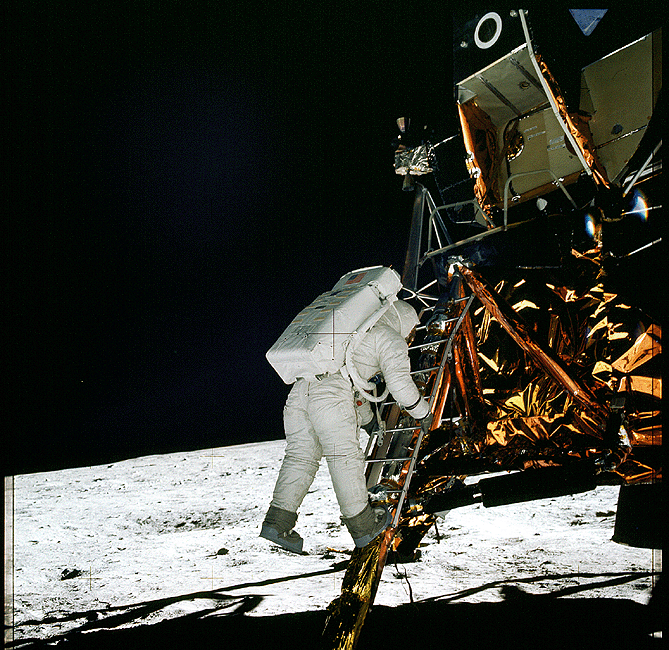
In the 70's and 80's, the most brilliant scientists in the world taped over the original recordings of the 1969 Lunar landing. As a result, we have only fuzzy recordings of the original broadcast. Hollywood technicians are producing the equivalent to eclectic texts by reconstructing images from four different recordings. These videos are being released in commemoration of the 40th anniversary of the landing. This makes an excellent analogy for what textual critics hope to accomplish, although the NASA situation is much more straightforward. An important parallel between the reconstruction of an image and a text lies in the fact that both are made of many different parts (pixels, colors / words, syntax) which form a larger whole. For the most part, the reconstruction does not change the picture, but only makes it clearer.

Associated Press article

View the restored images

Tuesday, July 14, 2009

Coptic Manuscripts on Ebay

3
Every once in a while, I check what is being ripped to pieces and put on sale over at Ebay. I notice today that there are actually a number of whole manuscripts on sale, which is something of an improvement. In addition to the separation of manuscripts, I find the sales to be particularly duplicitous; Bohairic (Coptic) manuscripts are often advertised as 11th century which would be equivalent to finding a 6th century Greek uncial. Our earliest Classical Bohairic manuscripts come from the 11th century (although there is a catena from the 9th, and two continuous old Bohairic manuscripts from the 4th). It would be a wonder if this particular Turkish seller had found a treasure trove of 11th century manuscripts! Most Bohairic manuscripts date to the 18th and 19th centuries. If I knew how to report him, I would.

Caveat emptor!

In my opinion, ancient manuscripts should only be sold on Ebay under two conditions.
1) Each manuscript must be digitized.
2) Each manuscript must be classified by a designated scholar.

Scholars could volunteer their opinions. Buyer and seller would both be protected. Ebay's reputation would remain sound. It would not take a great deal of time on anyone's part, and would at least produce a (somewhat shoddy) image database of manuscripts which would otherwise be destroyed.