

The latest issue of the Journal of Biblical Literature is out, i.e. volume 124.4 (2005). It contains the following article by D.A. Carson (pp. 693-714):
'Syntactical and Text-Critical Observations on John 20:30–31: One More Round on the Purpose of the Fourth Gospel'.
Monday, January 09, 2006
Ehrman's preferred title
On Wieland Willker's e-mail list, textualcriticism@yahoogroups.com, Bart Ehrman repeated what he said at SBL in Philadelphia, namely that he had wanted another title for his Misquoting Jesus. I quote:
'The title, btw, wasn't at all my idea. In fact, I was strongly against it. I wanted to call the book "Lost in Transmission."'
I suppose this just raises the question as to what exactly was lost. This title doesn't appear to fit the content of the work any better.
Previous comments here.
'The title, btw, wasn't at all my idea. In fact, I was strongly against it. I wanted to call the book "Lost in Transmission."'
I suppose this just raises the question as to what exactly was lost. This title doesn't appear to fit the content of the work any better.
Previous comments here.
Saturday, January 07, 2006
Papyrus seeds or plant wanted
Does anyone know a good source to obtain papyrus seeds, or alternatively a full plant? Any advice for someone living in the north of Scotland who wants to grow them?
Friday, January 06, 2006
Accents in Robinson and Pierpont (final)
I've now finished my list of accentual and similar errors in Maurice A. Robinson and William G. Pierpont, The New Testament in the Original Greek: Byzantine Textform (Chilton Book Publishing, 2005). I hope to post a review of others aspects of the work shortly.
Thursday, January 05, 2006
Dan Wallace reviews Misquoting Jesus
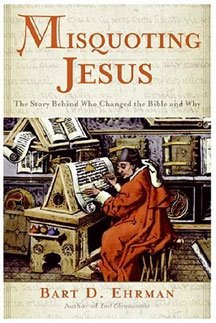 Dan Wallace has now written a review of Bart Ehrman's Misquoting Jesus on the Aspire2 Blog. His review takes the subject from a different but complementary angle to mine. I limit myself to one quotation:
'Unfortunately, as careful a scholar as Ehrman is, his treatment of major theological changes in the text of the NT tends to fall under one of two criticisms: Either his textual decisions are wrong, or his interpretation is wrong. These criticisms were made of his earlier work, Orthodox Corruption of Scripture, which Misquoting Jesus has drawn from extensively. Yet, the conclusions that he put forth there are still stated here without recognition of some of the severe criticisms of his work the first go-around.'
God-given words and textual criticism
Back in October I posted a query about the strengths and weaknesses of evangelical textual criticism. In the light of the discussion of Ehrman’s Misquoting Jesus it seems that we might benefit from further discussion of this. In particular it would be worthwhile discussing the problems posed by textual criticism for the idea that God inspired particular words and their sequence within scripture.
Verbal inspiration is not merely an evangelical concept, but one presupposed in OT phrases that speak of God’s ‘words’ (e.g. Ps. 119:130). This pre-Christian idea has at various times been embraced by a wide range of historic churches. In fact, verbal inspiration has proven such a powerful notion that it has even been attributed to translations of the Bible, e.g. the Septuagint, or part thereof (Philo, De Vita Mosis 2.37-38), Vulgate, and, in the last century, even the KJV. This of course raises the question of the extent of such inspiration. We should avoid multiplying unnecessarily entities that have been thus inspired. Protestants at the Reformation maintained that verbal inspiration applied to the Hebrew/Aramaic text of the OT and the Greek of the NT, and evangelicals have generally continued in the same belief. My questions are as follows:
1) What, according to textual criticism, are the principal problems with maintaining that the 39 + 27 books of the (Protestant) Bible are verbally inspired in the original languages?
2) What are the ways one might go about addressing these problems?
Verbal inspiration is not merely an evangelical concept, but one presupposed in OT phrases that speak of God’s ‘words’ (e.g. Ps. 119:130). This pre-Christian idea has at various times been embraced by a wide range of historic churches. In fact, verbal inspiration has proven such a powerful notion that it has even been attributed to translations of the Bible, e.g. the Septuagint, or part thereof (Philo, De Vita Mosis 2.37-38), Vulgate, and, in the last century, even the KJV. This of course raises the question of the extent of such inspiration. We should avoid multiplying unnecessarily entities that have been thus inspired. Protestants at the Reformation maintained that verbal inspiration applied to the Hebrew/Aramaic text of the OT and the Greek of the NT, and evangelicals have generally continued in the same belief. My questions are as follows:
1) What, according to textual criticism, are the principal problems with maintaining that the 39 + 27 books of the (Protestant) Bible are verbally inspired in the original languages?
2) What are the ways one might go about addressing these problems?
Subscribe to:
Posts
(
Atom
)