Showing posts with label pro-Byzantine. Show all posts

Monday, March 23, 2020

Festschrift for Maurice A. Robinson On-line

1
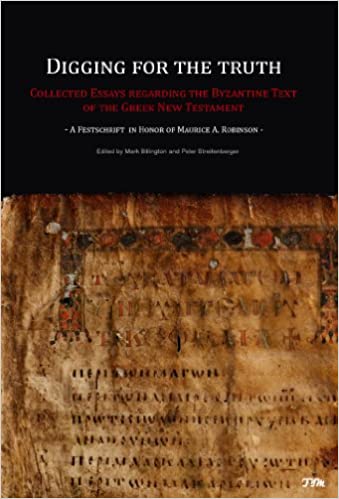
In 2014, Mark Billington and Peter Streitenberger edited a volume of essays, Digging for the Truth: Collected Essays Regarding the Byzantine Text of the Greek New Testament, to honor Maurice A. Robinson, Professor Emeritus of New Testament at Southeastern Baptist Theological Seminary (SEBTS).

One of the contributors to the volume, Abidan Paul Shah, former PhD student of Robinson, introduced the Festschrift at SEBTS and made available this videoclip of the presentation. At 4.20 you can see the honoree enter the stage to receive his book.

Since the book is now out of print, one of the editors, Peter Streitenberger, has now made it freely available here.

As readers will notice, the volume is written mainly from a pro-Byzantine text perspective, which is understandable since Robinson, in my opinion, is the most respected proponent of this school, which represent a very small minority of scholars in the discipline today. Read more about this perspective in Robinson’s own article, “The Case for Byzantine Priority,” in TC: A Journal of Biblical Textual Criticism.

Neverthelesss, it is a pity that there has not been another Festschrift for our co-blogger Maurice reflecting a wider perspective. I would have liked to contribute to that. On the other hand, I did participate in a symposium at SEBTS in 2014, invited by Maurice, to discuss the pericope adulterae, the text to which he has devoted much of his career (read my reports here and here with more links to summaries). The result of this consultation was published in The Pericope of the Adulteress in Contemporary Research, LNTS 551, ed. by D. A. Black and J. N. Cerone (London: Bloomsbury T&T Clark, 2016). See my announcement here.

Let me conclude this blogpost by citing from the preface of my recent book To Cast the First Stone (co-authored with Jennifer Knust) where I express my gratitude to Maurice as he reached out to a Swedish new-comer to the field:
Tommy would first like to thank Maurice Robinson, who was willing to suggest a topic for his bachelor’s thesis at Örebro School of Theology on a particularly interesting variant in the pericope adulterae, which led to his first research visit to the INTF in Münster and eventually resulted in his first academic publication [here]. In spite of different views regarding the history of the New Testament text, Maurice has always been gracious and helpful to both of us.

Wednesday, December 26, 2018

Another Important, Shorter Reading in the Byzantine Text

12
Earlier this year, I wrote about two important, shorter readings in the Byzantine text in 1 John 2.23; 3.1. I suggested that they were important because they both look to be simple omissions by parablepsis and so secondary readings. That said, I find it impossible to believe that the majority of manuscripts all independently agree in these omissions, which led me to conclude that
... in some cases, the Byzantine text goes back to a single exemplar that is not the autograph and not in agreement with our earliest extant Greek witnesses. These two cases also illustrate well the reality that no single text-type or manuscript has a corner on the original text all the time. In other words, why I’m a reasoned eclectic.
This past week I came across a similar case in John 19.3. Here is the text of vv. 2–3 in NA28
2 καὶ οἱ στρατιῶται πλέξαντες στέφανον ἐξ ἀκανθῶν ἐπέθηκαν αὐτοῦ τῇ κεφαλῇ καὶ ἱμάτιον πορφυροῦν περιέβαλον αὐτὸν 3 καὶ ἤρχοντο πρὸς αὐτὸν καὶ ἔλεγον· χαῖρε ὁ βασιλεὺς τῶν Ἰουδαίων· καὶ ἐδίδοσαν αὐτῷ ῥαπίσματα.
2 And the soldiers twisted together a crown of thorns and put it on his head and clothed him in a purple robe. 3 And they were coming to him, saying, “Hail, King of the Jews!” and struck him with their hands.
The evidence from the NA28 apparatus is:
  1. — A Ds K Γ Δ Ψ ƒ1 892s. 1241. 1424 𝔐 f q syp
  2. καὶ ἤρχοντο πρὸς αὐτὸν 𝔓66.90 ℵ B L N W Θ ƒ13 33. 565. 579. 700. ℓ 844 lat syh co
Unlike in the 1 John examples, here there is early support for the majority reading (A f q syp). But like those cases, the obvious explanation for the shorter reading is still omission caused by parablepsis (involving αὐτόν). The significance, again, is that we have here a shorter reading in the majority of manuscripts that goes back earlier but is still not likely to be original. And so, with apologies to MAR, it is yet one more reason why I am not a Byzantine prioritist.

Wednesday, April 18, 2018

Two important, shorter Byzantine readings in 1 John

26
In reading through 1 John with my Greek students this semester, I noticed two unexpected variants. They are both places where the Byzantine majority preserves a shorter reading that is easily explained as an accidental omission.

The full list of Greek data for 1 John 2.23 is in Text und Textwert, but the evidence from ECM is:
  1. πᾶς ὁ ἀρνούμενος τὸν υἱὸν οὐδὲ τὸν πατέρα ἔχει, ὁ ὁμολογῶν τὸν υἱὸν καὶ τὸν πατέρα ἔχει.
    01. 02. 03. 04. 025. 044. 5. 33. 61. 94. 104. 206. 218. 252. 254. 307. 321. 323. 326. 378C. 398. 429. 436. 442. 453. 459. 467C. 468. 522. 614. 621. 623. 630. 720. 808. 918. 996. 1067. 1127. 1243. 1292. 1359. 1409. 1448. 1490. 1505. 1523. 1524. 1563. 1611. 1661. 1678. 1718. 1735. 1739. 1751. 1799. 1831. 18372. 18382. 1842. 1844f. 1852. 1881. 2138. 2147. 2200. 2298. 2344. 2374. 2412. 2464. 2541. 2544. 2652. 2805. 2818. L596. L1281. Ath. Cyr. CyrH. Or. K:S>BV>. S:P>H. A. G:A1. Sl.Si. Ä
  2. πᾶς ὁ ἀρνούμενος τὸν υἱὸν οὐδὲ τὸν πατέρα ἔχει.
    6. 81. 88. 181. 378*. 467*. 629. 642. 915. 945. 1241. 1875. 2186. 2243. 2492. Byz [424*. 424C2]. PsOec. K:Bms. Sl:ChMS
While the minuscules are not unified here, there is still a clear Byz text identified by the ECM. Because of this unity, you will not find this variant in Robinson-Pierpont as a Byzantine variant though it is in the apparatus as an NA27 reading. The obvious explanation for the second reading is, of course, homoiteleuton (ἔχει ... ἔχει).

By way of illustration, here is the correction of the text in 424 adding the text back in followed by a second correction expunging it.

The double correction in 424. See in VMR
The second such omission is just a few verses later in 1 John 3.1. There the main evidence is
  1. Ἴδετε ποταπὴν ἀγάπην δέδωκεν ἡμῖν ὁ πατήρ, ἵνα τέκνα θεοῦ κληθῶμεν, καὶ ἐσμέν.
    01. 02. 03. 04. 025. 044. 5. 6. 33. 81. 94. 104. 206. 307. 321. 323. 378. 398. 4242. 429. 436. 442. 453. 459. 467. 522. 614. 621. 623. 629. 630. 918. 945. 996. 1067. 1127. 1243. 1292. 1409. 1490. 1505. 1523. 1524. 1611. 1735. 1739. 1799. 1831. 1838. 1842. 1844. 1852. 1881. 2138. 2147. 2200. 2298. 2344. 2374. 2412. 2464. 2541. 2652. 2805. 2818. L596. L:VT. A. G:A1. Sl:ChMSi
  2. Ἴδετε ποταπὴν ἀγάπην δέδωκεν ἡμῖν ὁ πατήρ, ἵνα τέκνα θεοῦ κληθῶμεν.
    61. 88. 181 . 218. 254. 326. 642. 808. 915. 1359. 1448. 1563. 1718. 1837. 1875. 2186. 2243. 2492. Byz [424T]. PSOeC. L:Vms. K:Sms>. Sl:S
Once again, we have the earliest evidence, several dozen minuscules, and most of the versions in favor of the longer reading and the Byzantine manuscripts in favor of the shorter. This variant won’t show up in the RP as an intra-Byzantine variant either. Again, the simplest explanation for the Byzantine reading is homoioteleuton, the eye skipping from -μεν to -μεν.

Klaus Wachtel (Der Bzyantinische Text, 302–303) also suggests that the shorter reading would be preferable because it removes the abrupt shift from subjunctive (κληθῶμεν) to indicative (ἐσμέν) following ἵνα. Confirming this as a possible motive is the fact that we find the subjunctive ὦμεν in 2544 and this appears to be what is translated by the Harklean Syriac and some Coptic witnesses. 

Here is this variant again in 424 showing another correction.

1 John 3.1 in 424. See in VMR
Both variants are pretty easy to deal with for reasoned and thoroughgoing eclectics and pretty difficult for Byzantine prioritists. It may be surprising to see the Byzantine tradition preserve such obvious mistakes, but in this, it also shows how careful the Byzantine scribes often were. It also suggests that, in some cases, the Byzantine text goes back to a single exemplar that is not the autograph and not in agreement with our earliest extant Greek witnesses. These two cases also illustrate well the reality that no single text-type or manuscript has a corner on the original text all the time. In other words, why I’m a reasoned eclectic.

Update (11/29/18): here is further info on the interesting way that the 1611 KJV handled 1 John 2.23.

Wednesday, September 09, 2015

ETC Interview with Maurice Robinson: Part 2

7
Posted below is the second part of my interview with Maurice Robinson. You can read part one here.


[PG] In a previous interview you said that, within a normal transmission process, we should expect to find the autographic text preserved “within a single dominant branch of the transmissional tradition.” What makes a branch “dominant” in your view and does this risk counting what should be weighed?

[MAR] Probably no greater conceptual misuse exists concerning the phrase “manuscripts should be weighed rather than counted” than when applied repeatedly to critique a presumed “majority text” type position, the obvious intent being to disparage such by a reductionist caricature of mere “nose-counting”. In reality, one first must define what constitutes “weight” and then determine the procedure for measurement and evaluation of such in the accompanying “weighing process”. Only then can one inquire as to what extent the constituent elements of such determined weight have actually been applied to each of the various MSS under consideration.

Monday, August 31, 2015

ETC Interview with Maurice Robinson: Part 1

5
If you’re still wondering, the answer to my quiz of last week is none other than that Byzantine Beatle, Maurice A. Robinson. Maurice also happens to be the first participant in what I hope will be an ongoing series of interviews with text critics. In the past, we have interviewed Bart Ehrman, Dan Wallace, and Stanley Porter and these were well received. So I thought we should continue the tradition. I don’t have any detailed criteria by which to pick our interviewees (suggestions welcome), but I can say I am quite pleased with those who have already agreed to be interviewed. There are many familiar names on the list, but also some lesser-known or younger scholars that I am excited to introduce to our readers. So without further ado, I present our first interview.

As a regular commentator and sometime contributor at the ETC blog, Maurice Robinson is no stranger to regular readers. But despite the blog’s great fame, he is most well-known for his work editing and defending the Byzantine textform. He teaches at Southeastern Baptist Theological Seminary in Wake Forest, NC where he was recently named research professor of New Testament studies. He’s been interviewed a number of times before, but I thought there were a few things those interviews didn’t cover, especially the final question of part 2. Enjoy!


Peter Gurry: Many readers might be surprised to learn that you worked with Kenneth W. Clark during your master’s work. Can you tell us how that relationship has (or hasn’t) influenced your own view of textual criticism?


[Maurice A. Robinson] I began studying with Clark (1898–1979) in 1971 during my MDiv program at Southeastern Baptist Theological Seminary (where I currently serve as Research Professor); this was arranged by the then text-critical professor here, since he said I already knew more about the subject from previous self-study than did he. Clark at that time was already emeritus from Duke, having retired from teaching in 1967, but he genuinely was excited about my interest in the field, since at that time very few students anywhere were becoming interested or involved in the subject. As a result, Clark and I began and maintained a very good relationship from 1971–1977 (when I moved to Texas for my PhD studies), despite our evangelical versus liberal theological differences.

My position at that time was one of reasoned eclecticism, basically following the Metzger-style theory and praxis; Clark, however, in various of his publications had already raised serious questions as to whether that or any type of eclectic method really represented a solution rather than a symptom (a theme later discussed by Epp in 1976). Clark therefore strongly encouraged me to study, heavily read, and critically examine various alternative views, including those favoring a primarily external and transmissional approach to the text as opposed to those theories that placed a more subjective emphasis on internal criteria (including both thoroughgoing and reasoned eclecticism). In essence, what Clark strongly suggested was a return back to primarily external principles such as espoused by Westcott and Hort, but without their unsupported speculative historical baggage regarding a “Syrian recension” being the creative cause of the Byzantine Textform.

Thursday, January 15, 2015

A Pro-Byzantine Textual Commentary

16
A textual commentary on passages that differs between the Nestle-Aland Novum Testamentum Graece (28th ed.) and the Robinson-Pierpont The New Testament in the Original Greek: Byzantine Textform (2005) is in the making.

The editors are Jonathan Borland and Mike Arcieri. According to Borland, "the commentary intends to supplement Metzger's by offering alternative views of the manuscript evidence held by various major editors of or commentators on the GNT over the last three centuries."

Thus far passages in Matt 1-7 have been treated.

Update: Maurice Robinson have explained that he is not contributing to the commentary so I removed his name.