Showing posts with label Krister Stendahl. Show all posts

Tuesday, December 22, 2020

The Goal of NTTC according to Eldon Epp

3
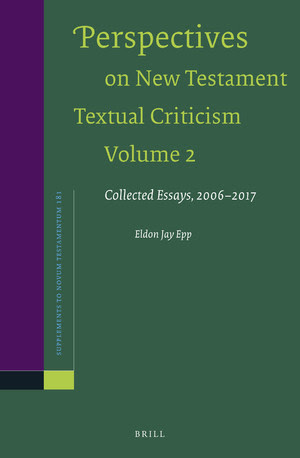
The second volume of Eldon J. Epp's collected essays and articles, Perspectives on New Testament Textual Criticism (covering 2006–2017) has just been published by Brill. Congratulations to the author who also turned 90 this year!

I have only browsed the volume, so for now I will just draw the attention to an introductory “notes for readers” which is freely accessible here, where Epp offers his own definition of the goal of New Testament Textual Criticism which he admits has varied, but as it stands now it is totally in line with my own view:

The Unitary Goal of New Testament Textual Criticism

New Testament textual criticism, employing aspects of both science and art, studies the transmission of the New Testament text and the manuscripts that facilitate its transmission, with the unitary goal (1) of establishing the earliest attainable text (which serves as a baseline), and at the same time (2) of assessing the textual variants that emerge from the baseline text so as to hear the narratives of early Christian thought and life that inhere in the array of meaningful variants.

Finally, I was also pleased to learn from the introduction “Developing Perspective” (accessible here) that Krister Stendahl from Sweden, then professor at Harvard University, gave the young doctoral student Epp the task to review a book on textual criticism by Fascher for the seminar and then with his other colleagues in the doctoral committee encouraged Epp to pursue a text-critical dissertation – well done! For another glimpse of Stendahl and a student at Harvard working on textual criticism in the 1950s, see here.

Friday, May 19, 2017

Krister Stendahl Working on the Textual Apparatus

3
Life Magazine (26 Dec 1955) featured an article by Alfred Eisenstaedt on Harvard Divinity School, “Harvard Revival. Back in touch with life of the churches its Divinity School gains a new vigor.” The article includes a curious photo of a group of three scholars working on analyzing textual variants in the New Testament using the latest high-tech, the Harvard Lab’s computer. I think this model might be Harvard Mark IV (built by Harvard engineers in 1952 under the supervision of Howard Aiken) or perhaps Rand´s Universal Automatic Computer (UNIVAC). Perhaps one of our readers can tell us which it is.


The doctoral student sitting at a desk is Rev. John W. Ellison who subsequently completed his thesis on “The Use of Electronic Computers in the Study of the Greek New Testament” (Harvard Divinity School, 1957).  Ellison also used UNIVAC to create a concordance of the NRSV text (published in 1957).

The scholar leaning over the desk is the Swedish Bishop and Harvard Professor Krister Stendahl. I don’t know who the third guy is, perhaps a computer technician. Does any reader know?

A former student of mine asked, when he saw this picture, “What is that big machine?” I replied that it is a textual apparatus.

Another pioneer in this field was Vinton A. Dearing, who wrote a program for the IBM 7090 to record and analyze variant readings. The results were published in Methods of Textual Editing, (Los Angeles: William Andrews Clark Memorial Library, UCLA, 1962).