Showing posts with label Geoff Smith. Show all posts

Tuesday, December 14, 2021

ECM of Mark Cites the Letter to Theodore (Secret Mark Stuff)

13

Yesterday, as I was consulting the recently published ECM of Mark, I came across some patristic citations by Clem (= Clemens of Alexandria) in several variation-units in the critical apparatus: Mark 10:32/2–40 (and related in /2–4, /6–10, /15); 10:34/26–30, 32; and 10:35/4, and 6. As I turned to part 2 Supplementary Material to find the particular references, it turned out that they were to EpTheod, (Morton) Smith 61,1; 61,2 and 63,2 (see image below from the Patristic Citations database online).
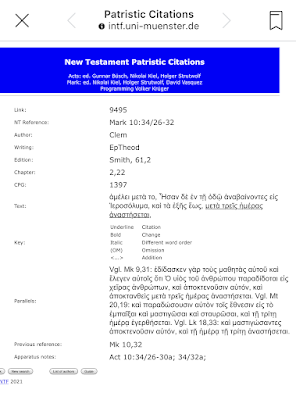
 

So, basically, these citations are from the controversial Letter to Theodore, which was discovered by Morton Smith in the Mar Saba monastery in the Judean Desert in 1958 in the back of a 1646–edition of Ignatius' Letters, copied by hand on the endpages. Smith took photographs of the pages and published his edition of the letter in 1973 (Greek text and Smith's photos here; English translation here). The implied author, Clemens of Alexandria, makes several references to both the (canonical) Mark and the infamous Secret Gospel of Mark (Theodore had posed questions about the latter; he apparently did not have a copy).  

There is an ongoing debate (though it has been a bit quiet lately) about whether this letter is genuine or a forgery (by Smith). For an introduction and negative assessment, see Stephen C. Carlson, The Gospel Hoax: Morton Smith's Invention of Secret Mark (Waco, TX: Baylor, 2005). For debate, see Tony Burke, ed., Ancient Gospel or Modern Forgery? The Secret Gospel of Mark in Debate (Eugene: Cascade Books, 2013).

I have heard that Geoffrey Smith and Brent Landau are currently working on a new book, The Secret Gospel of Mark: A Rogue Scholar, A Controversial Gospel of Jesus, and the Fierce Debate Over Its Authenticity (Yale University Press, 2022?). Does someone know what they will argue? We will see whether they will put an end to the debate.

In any case, these patristic citations are not included in Nestle-Aland 28, but will they be included in Nestle-Aland 29? I hope not, perhaps it was just a mistake. In my opinion, these citations should be treated with great caution and not on a par with Clement's other writings. What is your opinion?

If you are all fed up with this topic, you can always listen to and sing along with us at the ETC blogdinner in San Diego here.

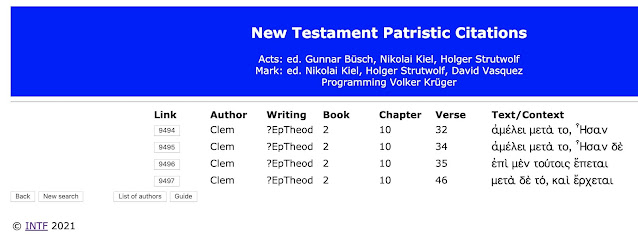
Update: Greg Paulson of the INTF informs us in a comment to the original post that, in light of this information, the editors have decided to add question marks to the references to EpTheod in the database (see image below), and "until a better scholarly consensus is reached" (of its genuineness), it will not be included in future Nestle-Aland editions. I am glad we caught this one.


Monday, May 01, 2017

Meet P132 and P133, Ephesians and 1 Timothy

5
P.Oxy. 5258 and 5259 are now P132 and P133. They contain text from Eph 3.21; 4.2, 14-16 and 1 Tim 3.13-4.8 and date to III/IV and III centuries, respectively. The editio princeps for each has been published by Geoffrey Smith and J. Shao and is online here.

P133 is now the earliest copy of 1 Timothy. Aside from this, there are some interesting things about P133.
In one case 5259 [P133] agrees with two MSS against the majority of witnesses (see ↓ 2 n.; see also ↓ 27 n.). In another it presents an elision occurring in only two other MSS against the majority of witnesses (see ↓ 5). Additional variants can only be inferred from the size of the lacunae. Notably, 5259 contains a previously unattested form of a nomen sacrum (see ↓ 22 n.).
I don’t have images for P133, but here is P132 courtesy of Smith. He also says his edition of P134 should be out in the next few months (on which, see Tommy’s post here).

P132, recto
P132, verso

While we’re on the topic of papyri, I know there are good reasons for moving away from “recto” and “verso,” but can we not do better than using left and right arrows to refer to the respective sides? These sigla face the same problems as Gothic letters, don’t they?

Monday, November 30, 2015

New Papyrus (P134) of John: A Report from SBL

11
Here is a report from the session on Christian Apocrypha joint with Papyrology and Early Christian Backgrounds at SBL Atlanta on 21 November.

The first paper in this session was presented by Geoffrey Smith who always has very interesting presentations. Some years ago, he presented on a new amulet which contained Mark 1:1-2 (without "Son of God" to the great satisfaction of Peter Head who sat next to me; it was then I decided to write an article on that topic).

This time he presented a "Preliminary Report on the 'Willoughby Papyrus' of the Gospel of John and an unidentified Christian Text." Just before the SBL, the papyrus was featured in the New York Times (see blogpost here). We already knew that it was found in the possessions of the late Harold R. Willoughby, a well-known scholar and bibliophile (who was also involved in the purchase of Archaic Mark by the University of Chicago). Apparently, if I remember correctly,  a relative of Willoughby pulled out a drawer in a box on an attic, and the manuscript fell on the floor. There was also this small inventory list mentioning other MSS, which have not been found.

The fragment went up for sale on eBay as noted by Brice Jones who alerted the scholarly world via his blog. Smith contacted the seller and informed him about the MS with the result that the seller stopped the auction. Smith got permission to study and publish
the papyrus. He took images of the MS in March, which he showed in his presentation.

The fragment has now been registered as Gregory-Aland Papyrus 134. The MS was folded at least once in Antiquity, possibly it was folded twice. (However, as someone pointed out, the folds can simply be the result of the papyrus roll being pressed together.) The recto contains six fragmentary lines with text from John 1:49-2:1 (end of the calling of Nathanael, beginning of wedding in Cana). The lines are rather long (only about half of each line is extant, and in our reconstruction, we do not know to what extent lost letters came before or after the extant text). The verso is an unknown Christian text which is not reconstructable from any known text in the TLG database. There are nomina sacra on both sides. The same scribe seems to have copied both sides in an informal cursive hand. Smith dates it to 250-350.

In sum, there are notable (unusual) features with this MS: (1) God (θεος) in v. 49 is not abbreviated as a nomen sacrum; (2) The continuous text is written on the recto of a scroll; (3) The verso contains an apocryphal text.

In regard to nomina sacra, there are other examples of scribes who were inconsistent, e.g., πνευμα in P46 is not always abbreviated (as noted in a recent article in NTS). In regard to the unusual format, after John was copied, the MS was flipped and written on the other side. This text was written up-side-down, which is normal on a bookroll, if you want to read and unroll the second text after you have read the first text (as noted by Brent Nongbri in the Q/A; apparently, P. Oxy. 654 is an exception in this regard).

However, could the MS have been an amulet which was reused later? Both the dialouge with Natanael and the wedding at Cana hare texts attested in other amulets (P. Berlin 11710 and P. Vindob. G2312, respectively). But the presence of both texts in a continuous narrative makes Smith doubt this identification.  Could it be a hermeneia, or a writing exercice? We cannot know.

In the Q/A session, several things came up. For example, the fact that in the corpora we have from Oxyrhynchus of some 180 published ophistographs (reused rolls), a documentary roll is normally reused for a literary text, or, vice versa, a literary roll is used for documentary purpose. Only P. Oxy. 4667 (=P. Oxy. 657) is an exception with Livy in Latin and then reused for the Epistle to the Hebrews. What does it mean that the same hand seems to have copied both texts? Did it stay in the same context (library/household)?

Saturday, November 21, 2015

A New Papyrus of the Gospel of John

15
Today I will attend the Papyrology and Early Christian Backgrounds session at the SBL in Atlanta. The first paper by Geoff S. Smith, University of Texas at Austin, is of particular interest:
Preliminary Report on the “Willoughby Papyrus” of the Gospel of John and an Unidentified Christian Text
Formerly in the possession of Harold Willoughby of the University of Chicago, this unpublished fragment of the Gospel of John in Greek created a stir when it appeared briefly on a well-known auction site in January of 2015. Having obtained permission from the owner to edit and publish the manuscript, I will offer in this presentation the initial results of my analysis of the so-called “Willoughby Papyrus.” I will demonstrate that this fragment complies with the 1970 UNESCO convention on cultural property and discuss the circumstances of its discovery and rediscovery. On the basis of new images of the fragment, I will also provide a transcription of the text, discuss its apparent bookroll format, and assess its text-critical value. Finally, I will present the secondary text on the verso and entertain the possibility that it belongs to an otherwise unknown Christian apocryphal text.

The papyrus made it to the news in New York Times yesterday with an image of the verso with the secondary text (apparently up-side-down compared with the recto).


The first time I heard about the fragment of John was actually from Brice J. Jones blog in April this year, when he blogged about A Greek Papyrus of the Gospel of John for Sale on eBay. Jones posted an image of the papyrus and an accompanying note of Willoughby's inventory and the seller's description:
“Very rare ancient papyrus fragment in Greek, John I 50-51 in it’s original display glass and sleeve. This is part of the MS collection of Harold R. Willoughby, who did extensive research with Edgar Goodspeed. Mr. Willoughby was a world traveler, and well-known professor of Theology at the University of Chicago. At the time of his death, he had a library of over 3500 rare bibles. This case with fragment, literally fell out of a stack of letters. I'm sure it was tucked away for security. Mr. Willoughby was a relative, and I attest this info to be true. Good luck bidding on a very rare piece with no reserve.”
According to the description, the seller is a relative of Mr. Willoughby. We will see if Geoff Smith has more to say today. Brice Jones also mentioned the accompanying note which listed several other items in Willoughby's collection. According to the list, the papyrus was one of three Greek New Testament manuscripts which seemed to be unregistered and without Gregory-Aland numbers.

Here is Brice Jones' description of the recto (John 1:50-51) based on the image then provided on eBay: 


The fragmentary papyrus contains 6 partial lines of text written with the fibers (-->). There are several strips of adhesive (front and back) that are presumably keeping the fragment in place. The image also shows two smaller, isolated fragments bearing ink but their placement is uncertain. The fragments are framed in between glass along with a card of identification that reads “John I, 50-51.” Presumably, there is writing only on one side, since there is no image of the other side and the card identifies text only on the front. If it is indeed written only on on side, then this would be very odd for a Greek New Testament papyrus. Normally, literary texts that are written on one side of a sheet of papyrus means that it is probably from a roll and not a codex. But in fact, none of the extant Greek New Testament papyri come from a roll (P22 is a question mark here). Thus, while the papyrus does bear witness to the text of the New Testament, we cannot rule out the possibility that it may be a fragment of an amulet—again, assuming that there is no text on the other side. In fact, two amulets cite passages from the immediate context. P.Berl. inv. 11710 cites John 1:49 and P.Vindob. G 2312 cites John 2:1-2. But we must suspend judgment about this matter until we can confirm that the other side is indeed blank. [Update: The seller has uploaded (rather shoddy) images of the other side confirming that there is writing; nomen sacrum is visible.]

The image is sufficient enough to attempt an analysis of the handwriting. The letters slope slightly to the right, are separated, undecorated, and roughly bilinear. The middle element of ψ descends well below the line, the oblique of ν connects high up on the second hasta, ο is small, the saddle of μ low. There is little contrast between thick and thin strokes, and punctuation and tremata are absent. This is a good example of what C.H. Roberts described as a “reformed documentary” hand and it exhibits many features typical of papyri that have been dated palaeographically to the 3rd-4th centuries. P.Oxy. 1079 (P18, 3rd-4th century) is a good example of this type of hand (cf., in particular, ν, ο, ε). While all palaeographical dating is inevitably tentative, the general impression of the handwriting suggests a date of 3rd-4th century.

The text is from John 1:50-51. I have provided a provisional transcript below in both diplomatic and full forms. 
3: It is not clear whether the papyrus reads μείζω (NA28) or μείζων (P75 037 579 1424 l 2211).

4: ὑμῖν ὄψεσθε follows the text of NA28 along with P66 P75 01 03 020 032s over against the reading ἀπ' ἄρτι found in many manuscripts whose scribes harmonized to Matt. 26:64 (including 02 017 036 037 038 Maj et al.).

5: Oddly, the scribe wrote the nomen sacrum θεοῦ in scriptio plena; cf. l. 6.

6: There is a faint trace of a supralinear stroke above the ν of υἱόν. ἀνθρώπου is also abbreviated.

–: The text appears to read καί τῇ τρίτῃ [ἡμέρᾳ], which is attested in some manuscripts (03 038 f13) over against the wider tradition.
I will post a brief report on Geoff Smith's presentation today, here in Atlanta.  Six years ago, at another SBL meeting in New Orleans, Geoff Smith presented a paper on a “New Oxyrhyncus Papyrus of Mark 1:1–2," which I reported about here and here (an except from my larger article on Mark 1:1). The question is whether this might be another amulet.